
Tag: CityEngine
8 posts tagged with "CityEngine"
ETH Zurich's Singapore-ETH Centre and the Future Cities Laboratory
The Singapore-ETH Centre for Global Environmental Sustainability (SEC) in Singapore was established as a collaboration between the National Research Foundation of Singapore and ETH Zurich in 2010. It is an institution that frames a number of research programmes, the first of which is the Future Cities Laboratory (FCL). The SEC strengthens the capacity of Singapore and Switzerland to research, understand and actively respond to the challenges of global environmental sustainability. It is motivated by an aspiration to realise the highest potentials for present and future societies. SEC serves as an intellectual hub for research, scholarship, entrepreneurship, postgraduate and postdoctoral training. It actively collaborates with local universities and research institutes and engages researchers with industry to facilitate technology transfer for the benefit of the public.
https://www.futurecities.ethz.ch/
I have been involved in Future Cities Laboratory since my return from UCSB in October 2008, and was the second PI to move to Singapore in October 2010, at that time located at temporary offices at the NUS School of Design and Environment. Main tasks included general ramp up of the centre, establishing technical infrastructure, hiring and supervision of PhD students. In January 2012, SEC moved into its permanent offices at the Singapore National Research Foundation (NRF) Campus for Research Excellence and Technological Enterprise (CREATE). I was responsible for the design and implementation of the [[ValueLabAsia |Value Lab Asia]], which was built in only three months and has been in operation since March 2012.

The Simulation Platform Research Module (“Module IX”): Service and Research for Future Planning Environments
Informing design and decision-making processes with new techniques and approaches to data acquisition, information visualisation and simulation for urban sustainability.
In science, simulations have assumed a critical role in mediating between theory and practical experiment. In architecture, simulations increasingly function in a similar way to help integrate the design, construction, and lifecycle management of buildings. And in urban planning, simulations have become an indispensable method for generating and analysing design and planning scenarios. The growing importance of simulation for these fields has been stimulated by a rapid growth in the availability of urban-related data. Despite this, most current simulations are capable of capturing and activating only a small fraction of the available data. Addressing this lack is both a matter of generating appropriate computer power to process the vast bodies of data, and accessing the data itself that is often held in hard to access databases. To contemplate possible advanced urban planning techniques that activate live and dynamic data, demonstrates that existing tools, such as GIS, are ill equipped to exploit the analytical and communicative potentials of this growing volume of urban data.
The Simulation Platform examines how to effectively deal with the growing volume of urban-related data. It investigates new techniques and instruments for the acquisition, organisation, retrieval, interaction, and visualisation of such data. It will propose techniques for designers, decision-makers and stakeholders to access necessary data about the city in innovative and dynamic ways. It does in two ways. First, it supports other research modules in the Future Cities Laboratory by supplying services such as data acquisition methods and visualisation facilities. Second, building on these services it will conduct original research on advanced and dynamic modelling, visualisation and simulation techniques that aim to better understand and intervene in the complex processes that shape contemporary cities.
Module Leader & PI: Prof Dr Gerhard Schmitt
Module Coordinator & PI: Assoc Prof (Adj) Dr Stefan Arisona
PIs: Prof Dr Armin Grün, Prof Dr Ludger Hovestadt, Prof Dr Ian Smith
Affiliated Faculty: Assoc Prof Dr Tat Jen Cham (NTU), Assoc Prof Dr Chandra Sekhar (NUS), Assoc Prof Dr Ian McLoughlin (NTU), Asst Prof Dr Philip Chi-Wing Fu, Asst Prof Dr Benny Raphael (NUS), Prof Dr Luc Van Gool (ETH Zurich), Asst Prof Dr Jianxin Wu (NTU)
PostDocs: Dr Matthias Berger, Dr Xianfeng Huang, Dr Tao Wang
PhD Students: Gideon Aschwanden, Dengxin Dai, Eva Friedrich, Vahid Moosavi, Maria Papadopoulou, Rongjun Qin, Dongyoun Shin, Sing Kuang Tan, Didier Vernay, Wei Zeng, Chen Zhong
IT Engineers: Daniel Sin, Chan Lwin
CityEngine - 3D City Modeling for Architecture, Film, and Games
ArcGIS CityEngine, is a 3D modeling software application developed by Esri R&D Center Zurich (formerly Procedural Inc.) and is specialized in the generation of three dimensional urban environments. With the procedural modeling approach, CityEngine enables the efficient creation of detailed large-scale 3D city models with merely a few clicks of the mouse instead of the time exhaustive & work intensive method of object creation & manual placement. CityEngine works with architectural object placement & arrangement in the same manner that VUE manages terrain, ecosystems & atmosphere mapping & is equally as diverse in its ability of object manipulation & environmantal conformity/harmony as its VUE counterpart. The recent acquisition of CityEngine by Esri is aiming to push the innovations in 3D GIS and Geodesign technology (from Wikipedia).
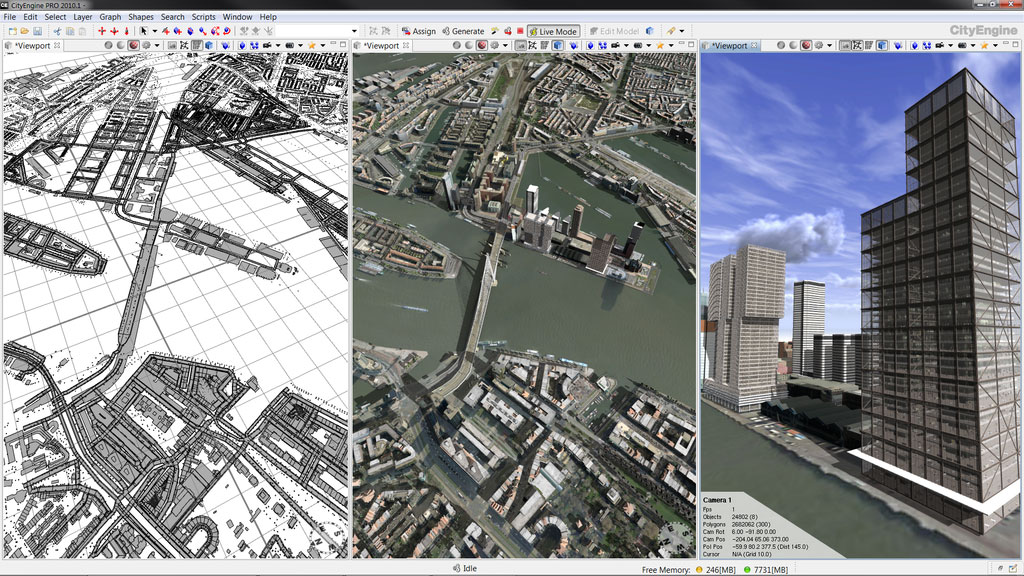
In 2008 I joined the ETH Zurich spin-off company Procedural Inc. as a software architect, and worked the general CityEngine software design, the real-time rendering core, and interactive 3D editing features.
CityEngine was quickly adopted by big players in different industry areas where fast 3D digital content creation is needed. Some examples are:
- Film: DreamWorks, Pixar, Weta Digital, Mr. X Inc., Fold7.
- Gaming: Blizzard Entertainment, Rockstar Games, Square Enix, THQ, Grasshopper Manufacture.
- Architecture and Urban Planning: Foster+Partners, Zaha Hadid Architects, SOM, Coop Himmelb(l)au.
- Government: Singapore Urban Redevelopment Authority, Brisbane City.
- Education: MIT, Stanford University, Harvard, Carnegie Mellon, ETH Zurich, Fraunhofer Gesellschaft.
- Others: Microsoft, IBM, Nvidia, Samsung.
More information: https://www.esri.com/software/cityengine
Company: Procedural Inc.
Position: Software Architect
Period: 2008 - 2011
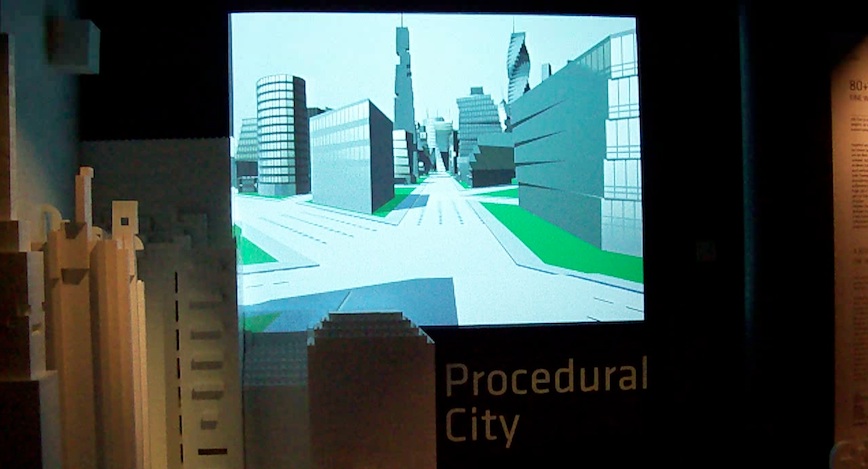
Procedural City - Biometric Cities at Your Fingerprints
Permanent Exhibition Ars Electronica Center, 2009 - 2012
Procedural City is an interactive media installation which has incorporated the generative modeling features of CityEngine along with a biometric fingerprint scanner. It enables the user to create his/her own personal city according to their fingerprint.
To interact with this installation the user scans his fingertip and subsequently the data is imported into CityEngine for processing. The fingerprint is analyzed to the point where CityEngine can generate street networks according to the pattern of the strongest lines. Once the streets are generated the buildings are ready to be modeled and this happens right in front of the users eyes. Finally a simple touch interface with navigation controls (actually an iPod) allows the user to explore the personalized city from all angles and perspectives.
The installation has been developed by Procedural Inc in collaboration with the Ars Electronica Futurelab, and is part of the GeoCity exhibition at the Ars Electronica Center (AEC) in Linz, Austria.
For more information on the foundation technology used, refer to the CityEngine page or to Esri’s CityEngine home page: https://www.esri.com/software/cityengine
https://www.youtube.com/watch?v=AMmsQ3KbQLI
Permanent Exhibition: Ars Electronica Center, Linz, Austria (16.6.2009 - 1.4.2012).
Additional exhibitions: Xi’an Academy of Fine Arts, Xi’an, China (July 02 – 16 2010). Maison D’Ailleurs, Yverdon-les-Bains, Switzerland (March 11 - December 09 2012), supported by the Game Culture Initiative of Pro Helvetia / Swiss Arts Council. Seoul National University Museum of Arts (October 10 - December 20 2014).
Concept, programming and realisation: Simon Schubiger and Stefan Arisona of Procedural Inc, AEC edition in collaboration with the AEC Futurelab.