
Tag: Digital Art
32 posts tagged with "Digital Art"
Corebounce & Scheinwerfer
Pascal Müller, Stefan Arisona, Simon Schubiger, Matthias Specht, since 2001
Corebounce is a collective of artists and scientists with the common goal of mediating between arts, science, and technology. We maintain a number of new media projects and our own multimedia software research platform, Soundium. We are organised as a non-profit association and collaborate with a number of partners from education, in particular with ETH Zürich, and industry.
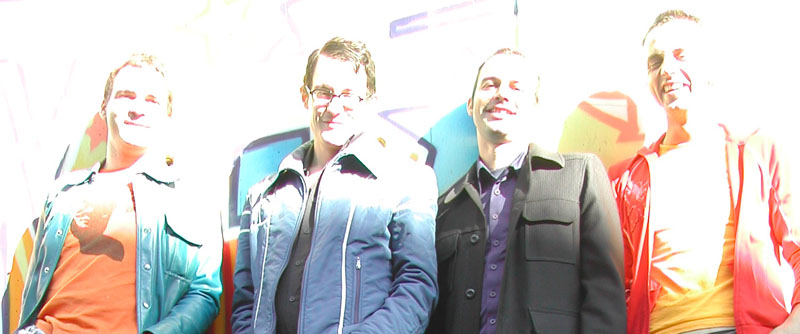
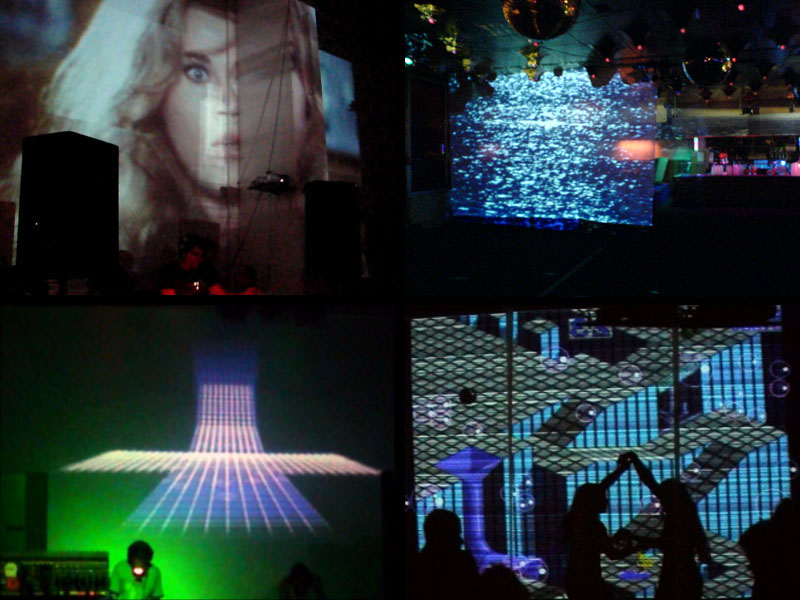
We regularly tour as the Scheinwerfer Live Visuals Collective, where we create the visual experience at various electronic music events since 2001. Our live-composited and sound-driven visuals are designed to emphasise the theme of the event as well as taking into account the architectural framework. Not coincidentally, we have been labelled as “Club Scientists”: As stated above, our performances are deeply influenced by the momentary state of the Soundium research software platform. At the same time research is typically induced by specfic artistic performance goals.
Scheinwerfer has performed at some of the coolest locations around the globe, supporting world-class DJs and musicians like Jeff Mills, Rush, Miss Kittin, Dave Clarke, Josh Wink, Mouse on Marks, Jimi Tenor and many more.
Virtual VJ
Steve Gibson and Stefan Arisona, since 2011
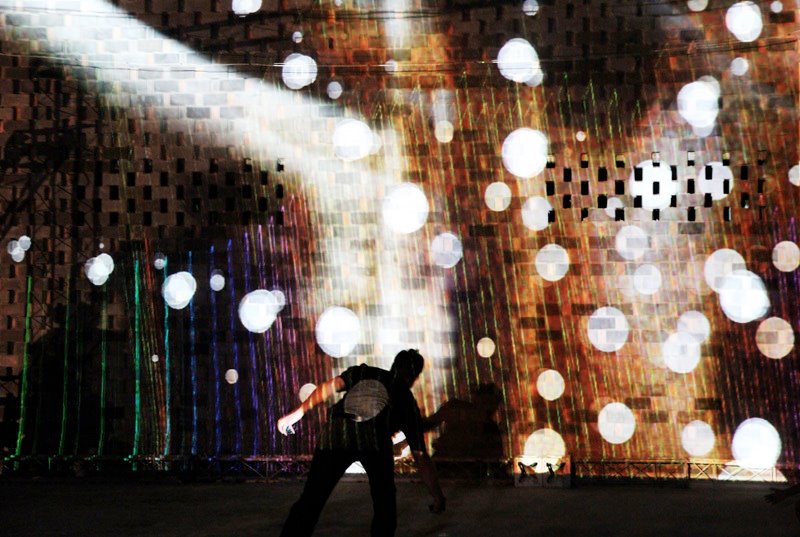
Virtual VJ takes the concept of Virtual DJ one step further and unites the role of the DJ and VJ into one interface: 3D space. The concept of Virtual VJ is to allow two or more users to control different aspects of the sound and video environment with their movements. One tracker is set to trigger sound and video and the other is set to manipulate the sound and video initiated by the first tracker. The focus of the media integration is on the development of observable connections between the audio and video mediums in order to assist the users with ease of interaction.
The key conceptual idea that is explored in Virtual VJ is the idea of cooperation and the sense of personal space in ephemeral, virtual systems. This is achieved by programming the trackers so that dramatic events happen when the two trackers are close together or far apart. For example the environment has been programmed so that the trackers apply distortion to the audio when they are proximate to each other. At the same time video effects are added when the same proximity of the two trackers is observed.
This can result in a game of cat and mouse where the users determine whether they will chose to closely follow the movements of the other participant or decide whether they wish to pursue a more individual experience. Audience members are allowed to interact in whatever manner they chose, but at the same time noticeable results will be produced as they inhabit similar spaces, encouraging them to cooperate with each in order to produce dramatic audio-visual results.
Documentation and videos at the VirtualVJ site: https://www.telebody.ws/VirtualDJ/virtualvj/virtualvj.html
3D tracking, sound, and programming: Steve Gibson
Visuals and programming: Stefan Arisona
History
- November 2011 - Duncan of Jordanstone College of Art & Design, Dundee, Scotland. Invited Exhibition
- August 2011 - Jade Valley Winery, Xi’an, China. Invited Exhibition
- July 2011 - The Interactive Experience, HCI 2011, Culture Lab, Newcastle University. Refereed exhibition
- May 2011 - Culture Lab CHI party, Intersections Digital Studio, Emily Carr University of Art and Design, Vancouver. Refereed exhibition
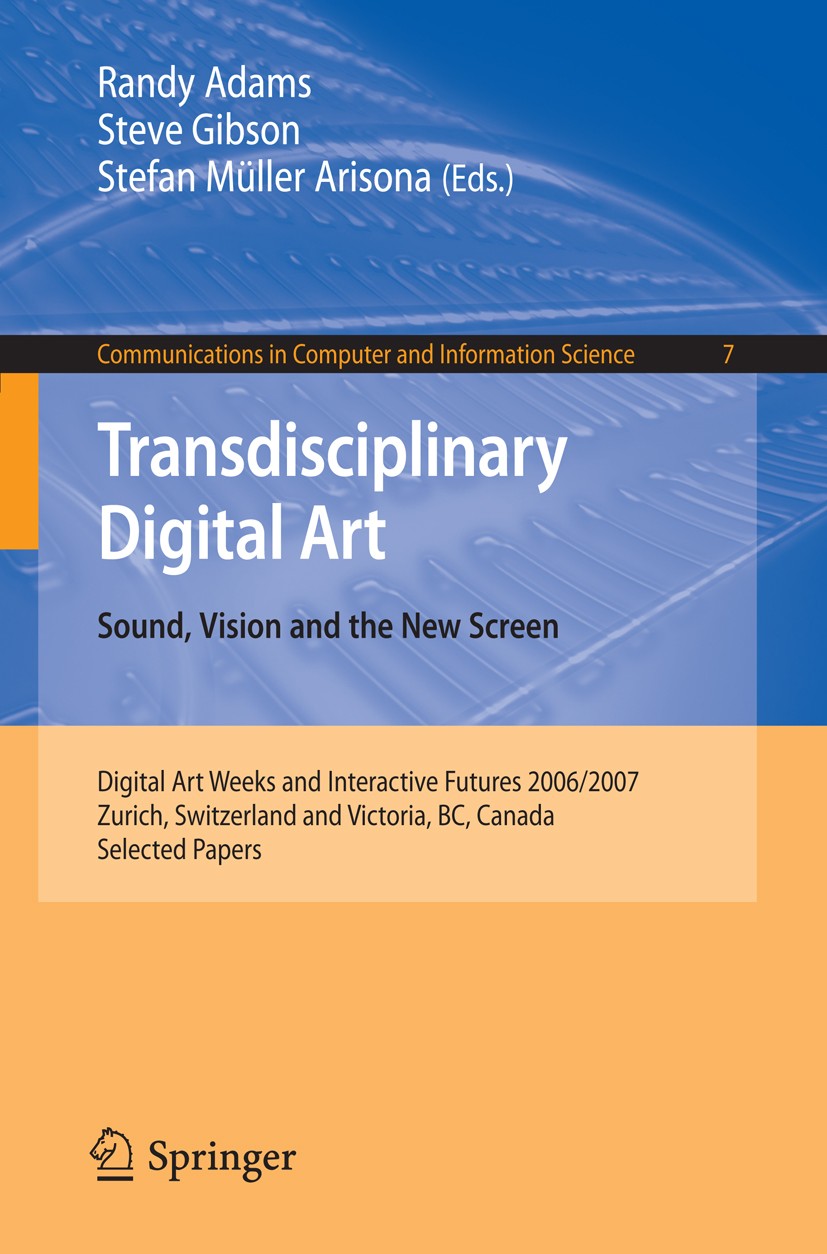
Book: Transdisciplinary Digital Art - Sound, Vision and the New Screen
Edited by Randy Adams, Steve Gibson, Stefan Arisona, 2008
This volume collects selected papers from the past two instances of Digital Art Weeks (Zurich, Switzerland) and Interactive Futures (Victoria, BC, Canada), two parallel festivals of digital media art. The work represented in Transdisciplinary Digital Art is a confirmation of the vitality and breadth of the digital arts. Collecting essays that broadly encompass the digital arts, Transdisciplinary Digital Art gives a clear overview of the on-going strength of scientific, philosophical, aesthetic and artistic research that makes digital art perhaps the defining medium of the 21st Century.
Contents
- Introduction: Why Tansdisciplinary Digital Art? - Steve Gibson
I Philosophies of the Digital
The Ethics of Aesthetics - Don Ritter
Ethical and Activist Considerations of the Technological Artwork - David Cecchetto
DIY: The Militant Embrace of Technology - Marcin Ramocki
Tuning in Rorschach Maps - Will Pappenheimer
Body Degree Zero: Anatomy of an Interactive Performance - Alan Dunning, Paul Woodrow
Artificial, Natural, Historical - Acoustic Ambiguities in Documentary Film - Julian Rohrhuber
The Colour of Time (God is a lobster and other forbidden bodies) - Johnny Golding
Behind the Screen: Installations from the Interactive Future - Ted Hiebert
II Digital Literacies
Transliteracy and New Media - Sue Thomas
Digital Archiving and “The New Screen” - John F. Barber
Digital Fiction: From the Page to the Screen - Kate Pullinger
The Present [Future] of Electronic Literature - Dene Grigar
Transient Passages: The Work of Peter Horvath - Celina Jeffery
III Multimedia Composition and Performance
Visceral Mobile Music Systems - Atau Tanaka
Designing a System for Supporting the Process of Making a Video Sequence - Shigeki Amitani, Ernest Edmonds
Video Game Audio Prototyping with Half-Life 2 - Leonard J. Paul
Computer-assisted Content Editing Techniques for Live Multimedia Performance - Stefan Arisona, Pascal Müller, Simon Schubiger-Banz, Matthias Specht
Computational Audiovisual Composition Using Lua - Wesley Smith, Graham Wakefield
Interrelation: Sound-Transformation and Re-Mixing in Real-Time - Hannes Raffaseder, Martin Parker
Functors for Music: The Rubato Composer System - Guerino Mazzola, Gerard Milmeister, Karim Morsy, Florian Thalmann
Inventing Malleable Scores: From Paper to Screen Based Scores - Arthur Clay
Glimmer: Creating New Connections - Jason Freeman
Variations on Variations - Daniel Peter Biro
IV Interfaces and Expression
Gestures, Interfaces and Other Secrets of the Stage - Eva Sjuve
Beyond the Threshold: The Dynamic Interface as Permeable Technology - Carolyn Guertin
CoPuppet: Collaborative Interaction in Virtual Puppetry - Paolo Bottoni, Stefano Faralli, Anna Labella, Alessio Malizia, Mario Pierro, Semi Ryu
Experiments in Digital Puppetry: Video Hybrids in Apples Quartz Composer - Ian Grant
Formalized and Non-Formalized Expression in Musical Interfaces - Cornelius Poepel
V Digital Space: Design, Movement, and Robotics
Interactive Spaces - Jeffrey Huang, Muriel Waldvogel
From Electric Devices to Electronic Behaviour - Stijn Ossevoort
Scentsory Design: Scent Whisper and Fashion Fluidics - Jennifer Tillotson
Advances in Expressive Animation in the Interactive Performance of a Butoh Dance - Jürg Gutknecht, Irena Kulka, Paul Lucowicz, Tom Stricker
Anthropocentrism and the Staging of Robots - Louis-Philippe Demers, Jana Horakova
VI Digital Performance in Urban Spaces
Imaging Place: Globalization and Immersive Media - John Craig Freeman
About… Software, Surveillance, Scariness, Subjectivity (and SVEN) - Amy Alexander
The NOVA Display System - Simon Schubiger-Banz, Martina Eberle
Four Wheel Drift - Petra Watson, Julie Andreyev
Publication Information
Collection: Digital Art Weeks and Interactive Futures 2006/2007, Zürich, Switzerland and Victoria, BC, Canada, Selected Papers
Publisher: Springer, Berlin Heidelberg
Series: Communications in Computer and Information Science , Vol. 7
Editors: Adams, Randy; Gibson, Steve; Arisona, Stefan (Eds.)
Year: 2008
ISBN: 978-3-540-79485-1
Link: https://www.springerlink.com/content/978-3-540-79485-1
ETH Zurich's Digital Art Weeks
I am co-founder and scientific director of ETH Zurich’s Digital Art Weeks. The Digital Art Weeks, an annually recurring festival, are concerned with the application of digital technology in the arts. Consisting of a symposium, workshops and performances, the program offers insight into current research and innovations in art and technology as well as illustrating resulting synergies in a series of performances, making artists aware of impulses in technology and scientists aware of the possibilities of the application of technology in the arts. In 2008 and 2010, a very successful version of Digital Art Weeks took place in Shanghai and Xi’an, China, and currently DAW'13 (early 2013) in Singapore is preparation…
https://www.digitalartweeks.ethz.ch/
One of my personal highlights of the series of past Digital Art Weeks was the special opening day and the keynote of Joseph Weizenbaum (1923-2008) in 2007, as I have always admired his ambivalent position towards computer and information technology. At DAW07, we also screened the documentary ‘Weizenbaum. Rebel at Work.’ by Peter Haas and Silvia Holzinger.
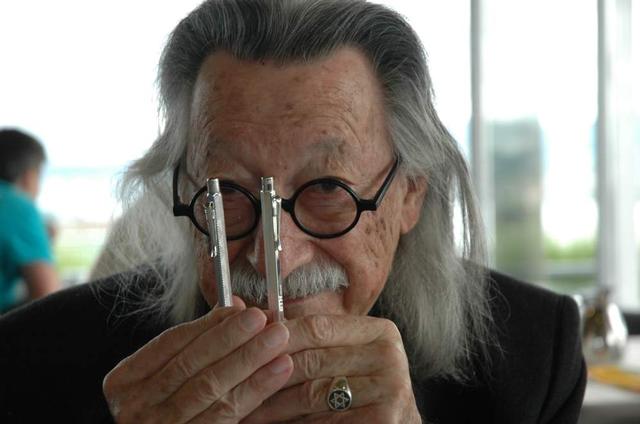
https://www.youtube.com/watch?v=5_LCLjqCTXs
Festival History
- 2013 - Singapore
- 2011 - Victoria, BC, Canada
- 2010 - Xi’an, China
- 2008 - Shanghai, China
- 2007 - Zurich, Switzerland
- 2006 - Zurich, Switzerland
- 2005 - Zurich, Switzerland
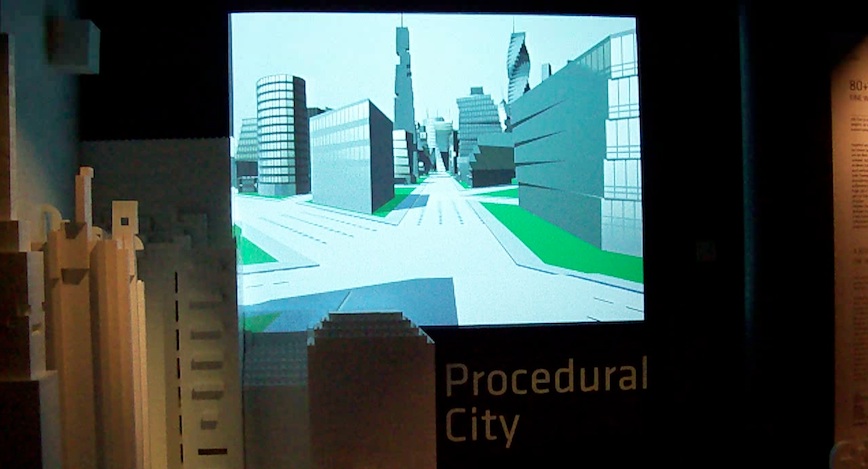
Procedural City - Biometric Cities at Your Fingerprints
Permanent Exhibition Ars Electronica Center, 2009 - 2012
Procedural City is an interactive media installation which has incorporated the generative modeling features of CityEngine along with a biometric fingerprint scanner. It enables the user to create his/her own personal city according to their fingerprint.
To interact with this installation the user scans his fingertip and subsequently the data is imported into CityEngine for processing. The fingerprint is analyzed to the point where CityEngine can generate street networks according to the pattern of the strongest lines. Once the streets are generated the buildings are ready to be modeled and this happens right in front of the users eyes. Finally a simple touch interface with navigation controls (actually an iPod) allows the user to explore the personalized city from all angles and perspectives.
The installation has been developed by Procedural Inc in collaboration with the Ars Electronica Futurelab, and is part of the GeoCity exhibition at the Ars Electronica Center (AEC) in Linz, Austria.
For more information on the foundation technology used, refer to the CityEngine page or to Esri’s CityEngine home page: https://www.esri.com/software/cityengine
https://www.youtube.com/watch?v=AMmsQ3KbQLI
Permanent Exhibition: Ars Electronica Center, Linz, Austria (16.6.2009 - 1.4.2012).
Additional exhibitions: Xi’an Academy of Fine Arts, Xi’an, China (July 02 – 16 2010). Maison D’Ailleurs, Yverdon-les-Bains, Switzerland (March 11 - December 09 2012), supported by the Game Culture Initiative of Pro Helvetia / Swiss Arts Council. Seoul National University Museum of Arts (October 10 - December 20 2014).
Concept, programming and realisation: Simon Schubiger and Stefan Arisona of Procedural Inc, AEC edition in collaboration with the AEC Futurelab.