
Tag: Future Cities Laboratory
16 posts tagged with "Future Cities Laboratory"

Open Call: Art/Science Residency at the Future Cities Laboratory
ASR 2013 Call For Proposals
Please find full call and application forms here: https://www.digitalartweeks.ethz.ch/web/DAW13/ASR2013
Arts/Science Residency with focus on Transmedia at ETH Zurich’s Future Cities Laboratory
The Singapore-ETH Centre, in collaboration with the Arts and Creativity Lab & the Interactive and Digital Media Institute, are pleased to announce a 2013 Arts/Science Residency at ETH Zurich’s Future Cities Laboratory (FCL). The selected artist will be invited to spend 2 months working at the FCL with researchers, students and the local arts community as she or he conduct a project exploring and making connections between art and science.
The artist will be invited to present the project at ETH Zurich’s Digital Art Weeks Festival (May 6 – 19 2013), thus the residency must start no later than beginning of May 2013.
The Art/Science Residency is made possible with the support of ETH Zurich’s Future Cities Laboratory and IDMI Art/Science Residency Programme.
Theme: Explorations in Transmedia for Urban Research
The Future Cities Laboratory (FCL) is a transdisciplinary research centre focused on urban sustainability in a global frame. It is the first research programme of the Singapore-ETH Centre for Global Environmental Sustainability (SEC). It is home to a community of over 100 PhD, postdoctoral and Professorial researchers working on diverse themes related to future cities and environmental sustainability.
In September 2013, the 3rd FCL Forum will take place at the NRF CREATE Campus in Singapore. The event is planned and realised through three main pillars, which are a conference, an exhibition, and the library. All pillars collected and showcase FCL work established over the last three years.
The goal of this Art/Science Residency is to propose and realise a bridge that connects the pillars. Thereby, the general topic of investigation is the use of transmedia storytelling approaches to support large, heterogeneous, and complex research projects in terms of coherently integrating the overall mission, research questions, works in progress and results across multiple platforms and formats. Consequently, proposals should radically question and innovatively revise current standards in academic communication. While including web- and game-based transmedia approaches, as typically known from advertisement, they should go beyond the norm of such techniques.
In particular, we are looking for proposals that include other areas and formats, and adhere to the following guidelines:
- Proposals should include use of the Value Lab Asia, a large collaborative, digitally augmented space, equipped with several multi-touch surfaces and displays, a 33 megapixel high-resolution video wall, and video conferencing systems. It is used by the FCL researchers for urban visualization, scenario planning and stakeholder participation applications.
- Proposals should have the openness to incorporate output from on going design research studios, seminars and research projects.
- Proposals should incorporate the evolving Future Cities Laboratory exhibition and the upcoming September 2013 conference, and the outcome of the project should be directly applicable for the exhibition and conference.
- Proposals may include design and production of physical models through digital fabrication.
For all formats and areas you will work closely with FCL faculty and PhD students, and will have access to FCL space and technical infrastructure, including the Value Lab and the FCL model-making workshop.
smartgeometry/sg13: Constructing for Uncertainty
Good news to start the year with: Our cluster proposal “Projections of Reality” has been accepted for this year’s smartgeometry at The Bartlett of UCL from 15 - 20 April 2013 in London.
Cluster gurus: Stefan Arisona, Eva Friedrich, Bruno Moser, Dominik Nuessen, Lukas Treyer.
Projections of reality will engage in augmenting design processes involving physical models with real time spatial analysis.
The cluster will explore techniques of real time spatial analysis of architectural and urban design models: how physical models can be augmented with real-time 3D capture and analysis, enabling the architect to interact with the physical model whilst obtaining feedback from a computational analysis. We will investigate possible workflows that close the cycle of designing and model making, analysing the design and feeding results back into the design cycle by projecting them back onto the physical model.
On a technical level, we are addressing the challenge of dealing with complex, unstructured data from real time scanning, e.g. a point cloud, which needs processing before it can be used in urban analysis. We will investigate strategies to extract information of the urban form targeted for design processes, using real time scanning devices (Microsoft Kinect, hand held laser scanners, etc.), open source 3D reconstruction software (reconstructMeQT) and post-processing of the input through parametric modelling (e.g. Processing, Rhino scripting, Generative Components).
The goal of the workshop will be to create a working prototype of a physical urban model that is augmented with real- time analysis. We will work with the cluster participants to formulate a design concept of the prototype and to break down the challenge into individual modules, e.g. analysing and cleaning the geometry, algorithms for real time analysis, projecting imagery onto the physical model.
Workshop applications are now open - check out these links for further information:
smartgeometry @ web: https://smartgeometry.org smartgeometry @ facebook: https://www.facebook.com/Smartgeometry
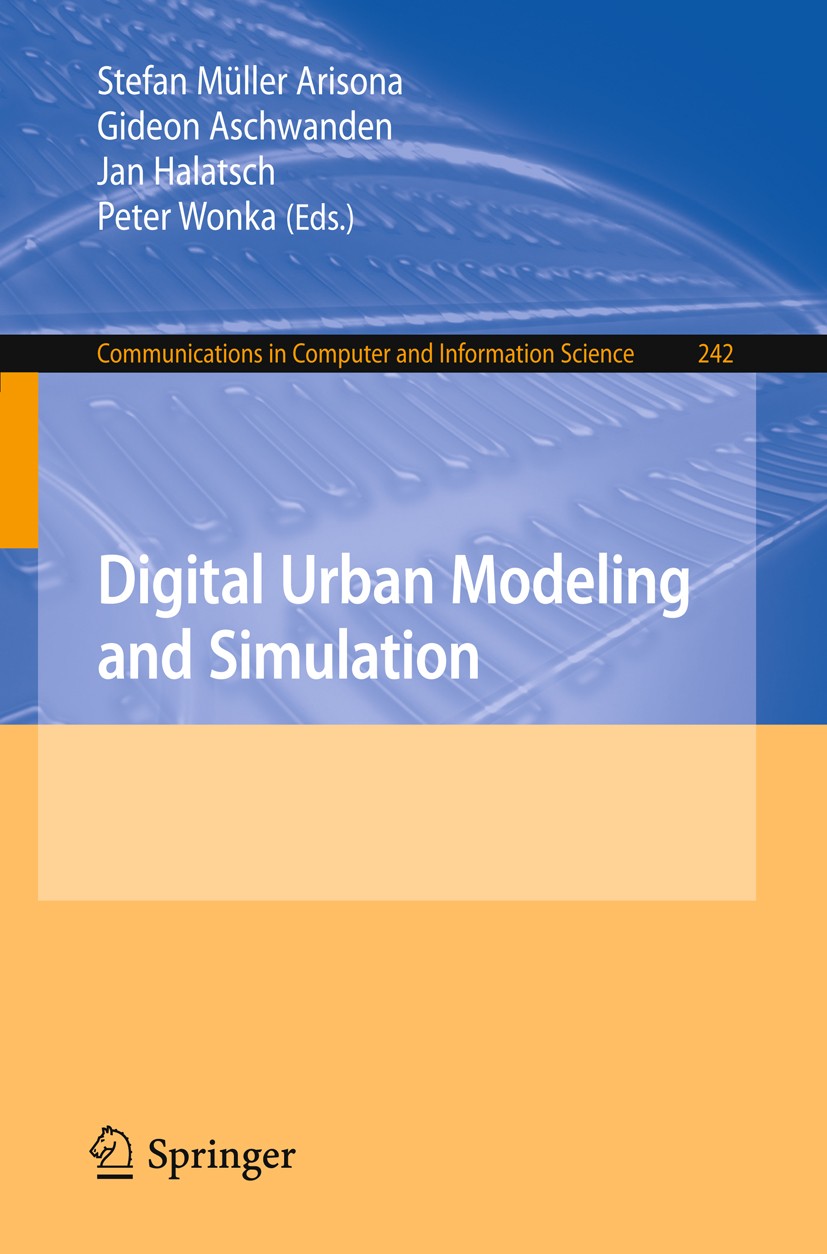
Book: Digital Urban Modeling and Simulation
Edited by Stefan Arisona, Gideon Aschwanden, Jan Halatsch, and Peter Wonka, 2012
About this Book
This book is thematically positioned at the intersections of Urban Design, Architecture, Civil Engineering and Computer Science, and it has the goal to provide specialists coming from respective fields a multi-angle overview of state-of-the-art work currently being carried out. It addresses both newcomers who wish to obtain more knowledge about this growing area of interest, as well as established researchers and practitioners who want to keep up to date. In terms of organization, the volume starts out with chapters looking at the domain at a wide-angle and then moves focus towards technical viewpoints and approaches. (Excerpt from preface by Stefan Arisona).
Contents
Part I: Introduction
A Planning Environment for the Design of Future Cities - Gerhard Schmitt
Calculating Cities - Bharat Dave
The City as a Socio-technical System: A Spatial Reformulation in the Light of the Levels Problem and the Parallel Problem - Bill Hillier
Technology-Augmented Changes in the Design and Delivery of the Built Environment - Martin Riese
Part II: Parametric Models and Information Modeling
City Induction: A Model for Formulating, Generating, and Evaluating Urban Designs - José P. Duarte, José N. Beirão, Nuno Montenegro, and Jorge Gil
Sortal Grammars for Urban Design: A Sortal Approach to Urban Data Modeling and Generation - Rudi Stouffs, José N. Beirão, and José P. Duarte
Sort Machines - Thomas Grasl and Athanassios Economou
Modeling Water Use for Sustainable Urban Design - Ramesh Krishnamurti, Tajin Biswas, and Tsung-Hsien Wang
Part III: Behavior Modeling and Simulation
Simulation Heuristics for Urban Design - Christian Derix, Åsmund Gamlesæter, Pablo Miranda, Lucy Helme, and Karl Kropf
Running Urban Microsimulations Consistently with Real-World Data - Gunnar Flötteröod and Michel Bierlaire
Urban Energy Flow Modelling: A Data-Aware Approach - Diane Perez and Darren Robinson
Interactive Large-Scale Crowd Simulation - Dinesh Manocha and Ming C. Lin
An Information Theoretical Approach to Crowd Simulation - Cagatay Turkay, Emre Koc, and Selim Balcisoy
Integrating Urban Simulation and Visualization - Daniel G. Aliaga
Part IV: Visualization, Collaboration and Interaction
Visualization and Decision Support Tools in Urban Planning - Antje Kunze, Remo Burkhard, Serge Gebhardt, and Bige Tuncer
Spatiotemporal Visualisation: A Survey and Outlook - Chen Zhong, Tao Wang, Wei Zeng, and Stefan Arisona
Multi-touch Wall Displays for Informational and Interactive Collaborative Space - Ian Vince McLoughlin, Li Ming Ang, and Wooi Boon Goh
Testing Guide Signs’ Visibility for Pedestrians in Motion by an Immersive Visual Simulation System - Ryuzo Ohno and Yohei Wada
Publication Information
Publisher: Springer, Berlin Heidelberg
Series: Communications in Computer and Information Science, Vol. 242
Editors: Arisona, S.; Aschwanden, G.; Halatsch, J.; Wonka, P.
Year: 2012
ISBN: 978-3-642-29757-1
Link: https://www.springeronline.com/978-3-642-29757-1
ETH Zurich's Singapore-ETH Centre and the Future Cities Laboratory
The Singapore-ETH Centre for Global Environmental Sustainability (SEC) in Singapore was established as a collaboration between the National Research Foundation of Singapore and ETH Zurich in 2010. It is an institution that frames a number of research programmes, the first of which is the Future Cities Laboratory (FCL). The SEC strengthens the capacity of Singapore and Switzerland to research, understand and actively respond to the challenges of global environmental sustainability. It is motivated by an aspiration to realise the highest potentials for present and future societies. SEC serves as an intellectual hub for research, scholarship, entrepreneurship, postgraduate and postdoctoral training. It actively collaborates with local universities and research institutes and engages researchers with industry to facilitate technology transfer for the benefit of the public.
https://www.futurecities.ethz.ch/
I have been involved in Future Cities Laboratory since my return from UCSB in October 2008, and was the second PI to move to Singapore in October 2010, at that time located at temporary offices at the NUS School of Design and Environment. Main tasks included general ramp up of the centre, establishing technical infrastructure, hiring and supervision of PhD students. In January 2012, SEC moved into its permanent offices at the Singapore National Research Foundation (NRF) Campus for Research Excellence and Technological Enterprise (CREATE). I was responsible for the design and implementation of the [[ValueLabAsia |Value Lab Asia]], which was built in only three months and has been in operation since March 2012.

The Simulation Platform Research Module (“Module IX”): Service and Research for Future Planning Environments
Informing design and decision-making processes with new techniques and approaches to data acquisition, information visualisation and simulation for urban sustainability.
In science, simulations have assumed a critical role in mediating between theory and practical experiment. In architecture, simulations increasingly function in a similar way to help integrate the design, construction, and lifecycle management of buildings. And in urban planning, simulations have become an indispensable method for generating and analysing design and planning scenarios. The growing importance of simulation for these fields has been stimulated by a rapid growth in the availability of urban-related data. Despite this, most current simulations are capable of capturing and activating only a small fraction of the available data. Addressing this lack is both a matter of generating appropriate computer power to process the vast bodies of data, and accessing the data itself that is often held in hard to access databases. To contemplate possible advanced urban planning techniques that activate live and dynamic data, demonstrates that existing tools, such as GIS, are ill equipped to exploit the analytical and communicative potentials of this growing volume of urban data.
The Simulation Platform examines how to effectively deal with the growing volume of urban-related data. It investigates new techniques and instruments for the acquisition, organisation, retrieval, interaction, and visualisation of such data. It will propose techniques for designers, decision-makers and stakeholders to access necessary data about the city in innovative and dynamic ways. It does in two ways. First, it supports other research modules in the Future Cities Laboratory by supplying services such as data acquisition methods and visualisation facilities. Second, building on these services it will conduct original research on advanced and dynamic modelling, visualisation and simulation techniques that aim to better understand and intervene in the complex processes that shape contemporary cities.
Module Leader & PI: Prof Dr Gerhard Schmitt
Module Coordinator & PI: Assoc Prof (Adj) Dr Stefan Arisona
PIs: Prof Dr Armin Grün, Prof Dr Ludger Hovestadt, Prof Dr Ian Smith
Affiliated Faculty: Assoc Prof Dr Tat Jen Cham (NTU), Assoc Prof Dr Chandra Sekhar (NUS), Assoc Prof Dr Ian McLoughlin (NTU), Asst Prof Dr Philip Chi-Wing Fu, Asst Prof Dr Benny Raphael (NUS), Prof Dr Luc Van Gool (ETH Zurich), Asst Prof Dr Jianxin Wu (NTU)
PostDocs: Dr Matthias Berger, Dr Xianfeng Huang, Dr Tao Wang
PhD Students: Gideon Aschwanden, Dengxin Dai, Eva Friedrich, Vahid Moosavi, Maria Papadopoulou, Rongjun Qin, Dongyoun Shin, Sing Kuang Tan, Didier Vernay, Wei Zeng, Chen Zhong
IT Engineers: Daniel Sin, Chan Lwin
The Value Lab Asia
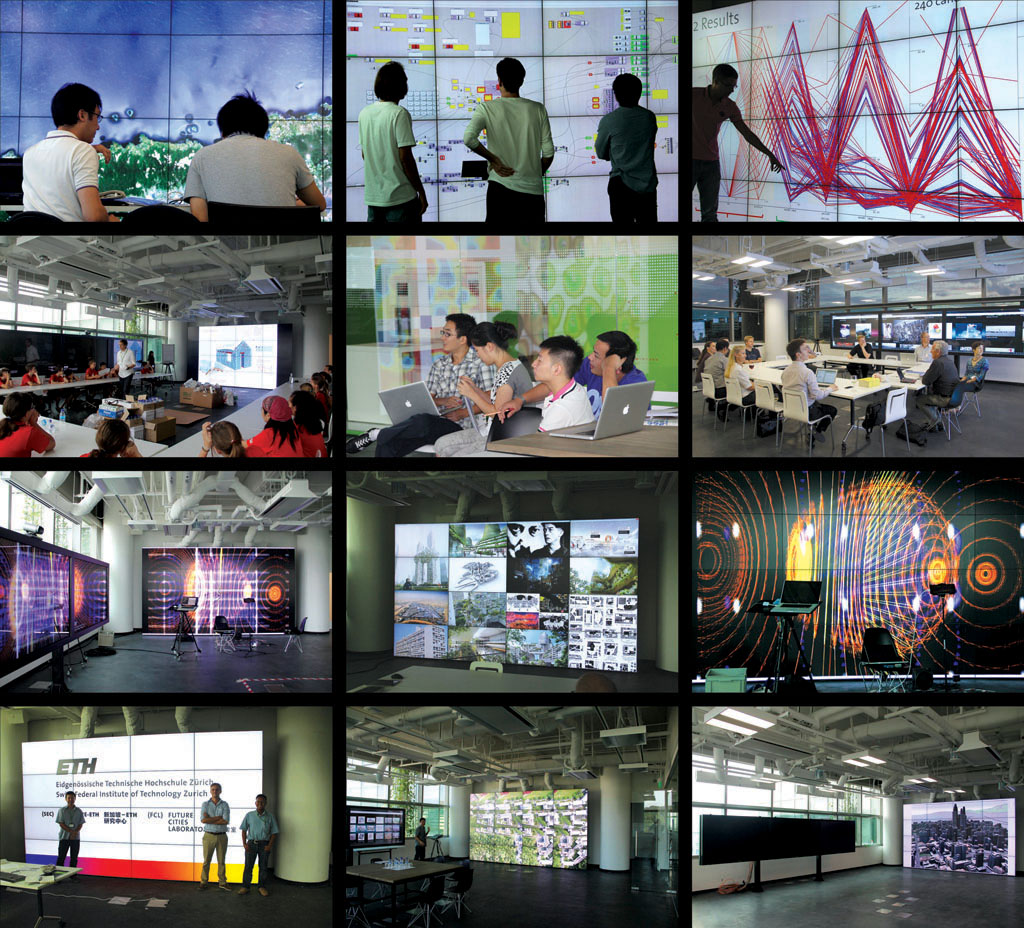
The Value Lab Asia is a collaborative, digitally augmented environment for a wide range of applications, such as participatory urban planning and design, stakeholder communication, information visualisation and discovery, remote teaching and conferencing. It includes a 33 megapixel video wall, three large displays with touch overlays, a number of smaller, mobile multi-touch enabled displays, and extensive video conferencing capabilities. The Value Lab Asia is the younger sibling of the Value Lab Zurich, built at ETH Zurich’s ScienceCity by Gerhard Schmitt, Remo Burkhard, Jan Halatsch and Antje Kunze of the Chair of Information Architecture in 2007/08. It therefore borrows many of the concepts of the Value Lab Zurich, such as being set in a friendly environment that operates in daylight conditions, however comes with updated state-of-the-art hardware and a different look.
The Value Lab Asia was conceived in the second half of 2011, and built in only two months from January 2012 to March 2012. It has been in regular operation since then. We are currently working on a more extensive documentation. Below you find the basic technical specifications.
If you are interested in visiting and/or using the facility, please feel free to contact me at arisona@arch.ethz.ch
Brief Technical Specifications
- Video wall, 4.9 x 2.7m, running at native 7680 x 4320 resolution (roughly 33 megapixels), driven from a single machine. Therefore, most applications run out of the box.
- Display wall with three 82" multi-touch displays, also driven from a single machine.
- Several 40" mobile multi-touch units, including mini-PC, thus completely autonomous.
- Tandberg-based video conferencing with one fixed and one mobile camera. Can be flexibly configured to run on video wall as well as display wall.
- Integrated video recording and production.
Institution: ETH Zurich’s Future Cities Laboratory
Location: Singapore
Period: Since 2011
Project lead, concept, system specification: Stefan Arisona
Interior design: Stefan Arisona in collaboration with Plasmadesign
System integration: PAVE System Pte Ltd