
Tag: Matthias Specht
5 posts tagged with "Matthias Specht"

Journal of Professional Communication: "Art/Science Hybrids"
Special Issue on Art/Science Hybrids. Journal of Professional Communication (JPC), Volume 3, Issue 2, 2013
https://digitalcommons.mcmaster.ca/jpc/
A collection of papers originally presented at Digital Art Weeks 2013 Singapore (DAW), https://www.digitalartweeks.ethz.ch/
Editor in chief: Alex Sévigny, McMaster University
Guest editors: Steve Gibson, Faculty of Art, Design and Social Science, Northumbria University, Newcastle, UK and Stefan Arisona, University of Applied Sciences and Arts Northwestern Switzerland FHNW / Future Cities Laboratory, ETH Zurich
The rise of new transdisciplinary practices in the late 20th and early 21st Centuries is striking. The gulf between art and science that has widened since the Enlightenment has now been challenged by a wide body of scholars, artists, designers and scientists. This special issue explores the concerns of emergent transdisciplinary research that seeks to re-unite the arts and sciences.
Table of Contents
Editorials
Preface to the JPC special issue on Art/Science Hybrids. Alex Sévigny
Art Into science/science into art. Steve Gibson
Iterative Emergence of Art/Science Hybrids. Stefan Arisona, Pascal Mueller, Simon Schubiger, and Matthias Specht
Commentary
Augmenting science through art. Matthias Berger
Next nature: ‘nature caused by people’. Sue Thomas
Interview
Interview with George Legrady, chair of the media arts & technology program at the University of California, Santa Barbara. Stefan Arisona
Research Articles
Art-science and verbal articulation in hyper-visual techno-culture. F. Scott Taylor
Theoretical aesthetics. Adam Tindale
Mapping art to systems thinking. Paul Goodfellow
The superhero and the DJ: Science meets design. Mikael Lindstrom, Farvash Razavi, and Nandi Novell
Social commentary through the transdisciplinary practice of audio-visual performance. Léon McCarthy
The digitization of music and the accessibility of the artist. Marius Carboni
Live programming for robotic fabrication. Jason Lim
Title: Art/Science Hybrids
Editor: Alex Sévigny
Guest Editors: Steve Gibson and Stefan Arisona
Journal: Journal of Profession Communication
Year: 2013
Volume: 3(2)
Link: https://digitalcommons.mcmaster.ca/jpc/
Corebounce & Scheinwerfer
Pascal Müller, Stefan Arisona, Simon Schubiger, Matthias Specht, since 2001
Corebounce is a collective of artists and scientists with the common goal of mediating between arts, science, and technology. We maintain a number of new media projects and our own multimedia software research platform, Soundium. We are organised as a non-profit association and collaborate with a number of partners from education, in particular with ETH Zürich, and industry.
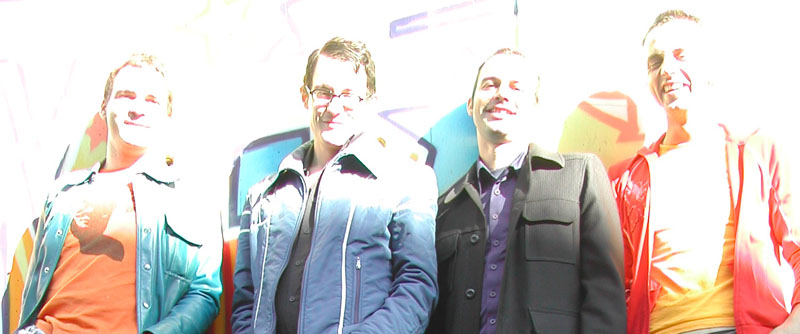
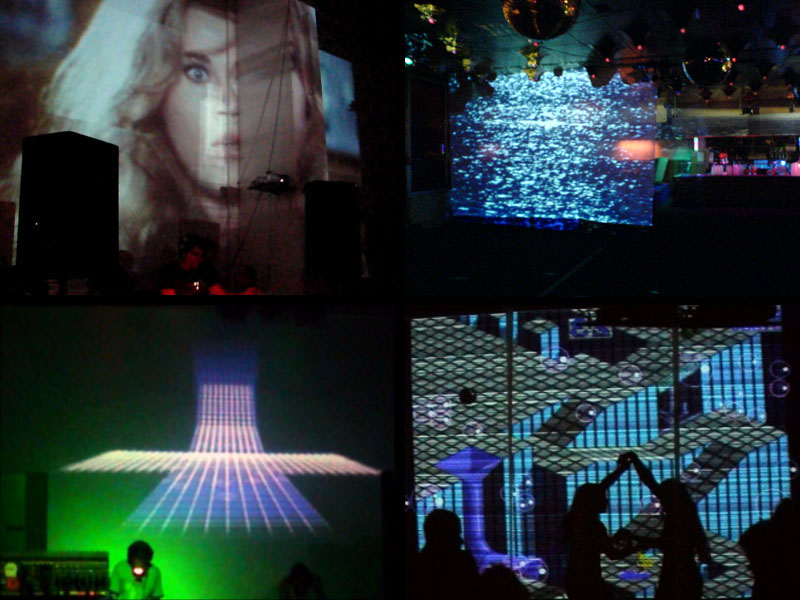
We regularly tour as the Scheinwerfer Live Visuals Collective, where we create the visual experience at various electronic music events since 2001. Our live-composited and sound-driven visuals are designed to emphasise the theme of the event as well as taking into account the architectural framework. Not coincidentally, we have been labelled as “Club Scientists”: As stated above, our performances are deeply influenced by the momentary state of the Soundium research software platform. At the same time research is typically induced by specfic artistic performance goals.
Scheinwerfer has performed at some of the coolest locations around the globe, supporting world-class DJs and musicians like Jeff Mills, Rush, Miss Kittin, Dave Clarke, Josh Wink, Mouse on Marks, Jimi Tenor and many more.
The Digital Marionette
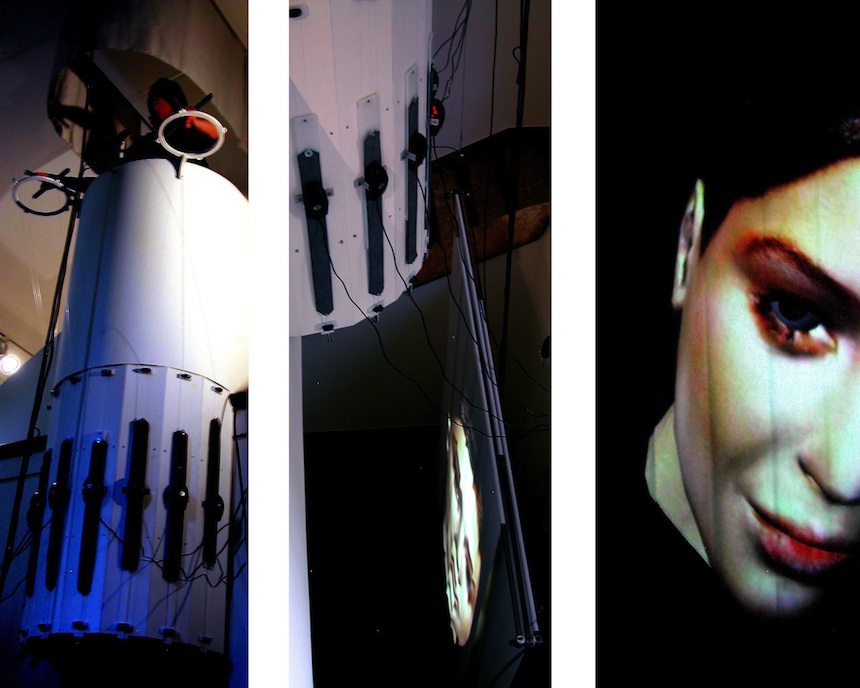
The interactive installation Digital Marionette impressively shows the audience the look and feel of a puppet in the multimedia era: The nicely dressed wooden marionette is replaced by a Lara Croft - like character; the traditional strings attached to puppet control handles emerge into a network of computer cables. The installation is currently exhibited at the Ars Electronica Center in Linz.
The installation consists of a projection of a digital face, which can be controlled by the visitors. The puppet can be made talking via speech input, and the classical puppet controls serve as controllers for head direction and face emotions, such as joy, anger, or sadness. The whole artistic concept was designed and realised in an interdisciplinary manner, incorporating art historical facts about marionettes, the architectural space, interaction design, and state of the art research results from computer graphics and speech recognition.
Concept
The translation from old to new, from analogue to digital, takes place via the most popular computer input device: the mouse. The puppet control handles are attached to sliding strips of mousepads and eight computer mice track movements of the individual strings. This approach is at the same time efficient, low-cost and easily understandable by the non-expert visitor. Speech input is realised via speech recognition, where the recognised phonemes are mapped to a set of facial expressions and visemes.
Exhibition at Museum Bellerive, Zurich, Switzerland, 2004
The first exhibition of the Marionette was realised in 2004 by the Corebounce Art Collective in cooperation with Christian Iten (interface realisation), Swisscom Innovations (Swiss-German voice recognition), and ETH Zürich (real-time face animation), and Eva Afuhs and Sergio Cavero (Curators, Museum Bellerive, Zürich).
Exhibition at Ars Electronica Centre, Linz, Austria, 2006 - 2008
An augmented permanent version of the installation was presented in the entrace hall of the world-famous Ars Electronica Center in Linz. It was realised by the Corebounce Art Collective with technical support from Gerhard Grafinger of the Ars Electronica Center. Furthermore we thank Ellen Fethke, Gerold Hofstadler and Nicoletta Blacher of Ars Electronica; and Jürg Gutknecht and Luc Van Gool of ETH Zürich.
Bellerive Installation Video
3D Concept Video
Additional Information
Exhibition: Museum Bellerive
Location: Zurich, Switzerland
Period: Jun 11 - Sep 12 2004
Exhibition: Ars Electronic Centre
Location: Linz, Austria
Period: Sep 2006 - Sep 2008
Concept and realisation: Corebounce Art Collective (Pascal Mueller, Stefan Arisona, Simon Schubiger, Matthias Specht)
Rip My Disk
Corebounce Art Collective, 2006
The project “Rip my Disk”, presented at Interactive Futures 2006, brought mobile art to the dancefloor. It compromised privacy by displaying personal content to the big screen.
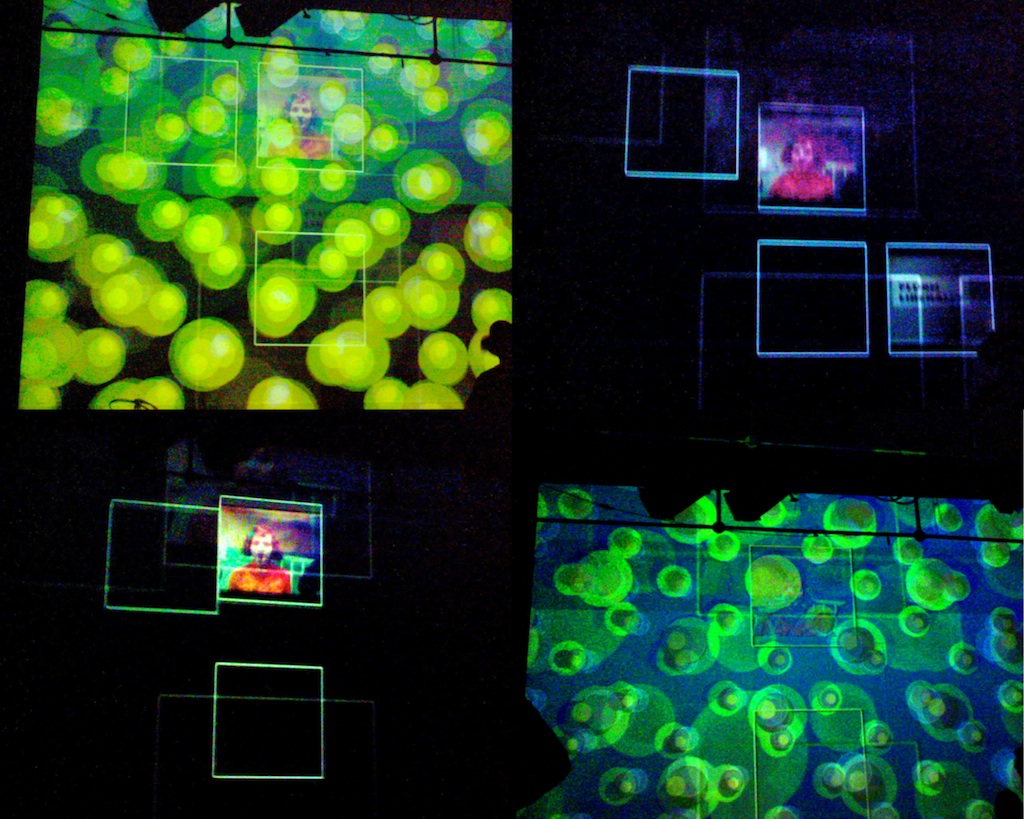
In an augmented VJ performance, visitors entered into a dare by letting the Corebounce team “rip” multimedia contents off their personal mobile phones with the Soundium program to get exposed (“virtually naked”) on the dance floor. Others, not so akin to risk taking, simply enjoyed to employ their mobile phones for interactive painting as well as sending media sources such as live video and image material. The sent media were used as personal artifacts, and were continuously adapted and integrated into the live visuals performance. The result was the personal enhancement of the space around the media owner’s location. The project also demonstrated how mobile communication technologies can easily be made accessible to artists or performers.
https://www.youtube.com/watch?v=Ut3D5Z4PoWg
Performance & Installation: Interactive Futures 06
Location: Open Space, Victoria, BC, Canada
Date: Jan 27 2006
Installation: Digital Art Weeks 07
Location: ETH Zurich, Switzerland
Date: Jul 10 - 14 2007
Concept, programming and realisation: Corebounce Art Collective
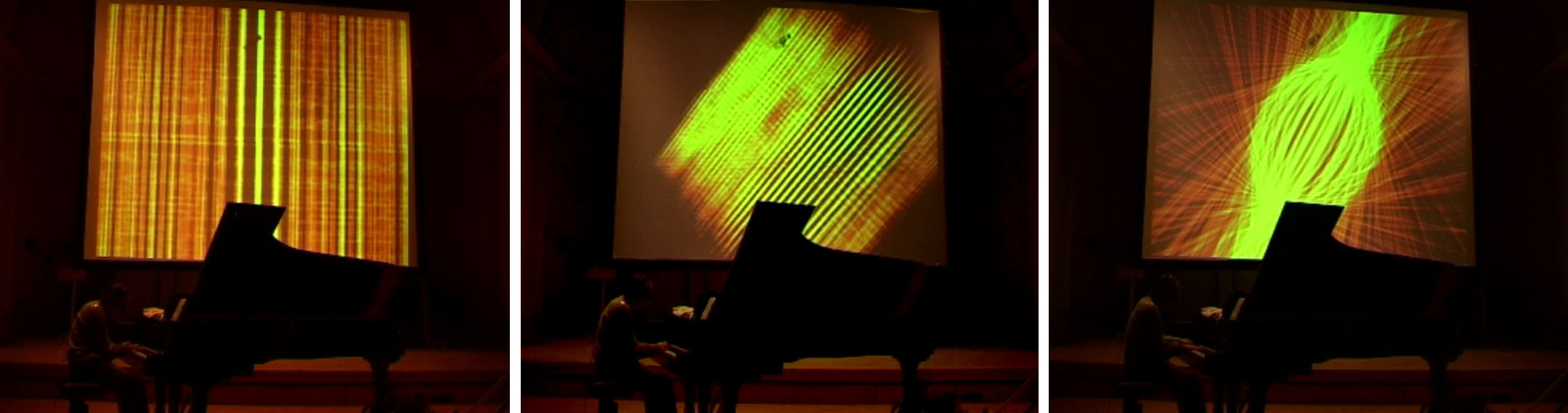
The Pianist's Brainwaves
Guerino Mazzola & Corebounce, 2002
Free jazz improvisation by Guerino Mazzola over a motif of Modest Mussorgsky’s “Pictures at an Exhibition” accompanied by an expressive live visuals interpretation. Instead of using DSP music analysis, the piece employed real-time EEG (Electroencephalogram) to sense and analyse Mazzola’s brainwaves. The retrieved parameters were then mapped to for spatial distributions and movements of geometric shapes and to different color modulations.
Event: Musik - Denken - Spielen
Location: School of Music, Drama and Dance, Zurich, Switzerland
Date: Oct 26 2002
Concept and Performance: Guerino Mazzola and Stefan Arisona
Programming: Corebounce