
Tag: Music
15 posts tagged with "Music"
Virtual VJ
Steve Gibson and Stefan Arisona, since 2011
Virtual VJ takes the concept of Virtual DJ one step further and unites the role of the DJ and VJ into one interface: 3D space. The concept of Virtual VJ is to allow two or more users to control different aspects of the sound and video environment with their movements. One tracker is set to trigger sound and video and the other is set to manipulate the sound and video initiated by the first tracker. The focus of the media integration is on the development of observable connections between the audio and video mediums in order to assist the users with ease of interaction.
The key conceptual idea that is explored in Virtual VJ is the idea of cooperation and the sense of personal space in ephemeral, virtual systems. This is achieved by programming the trackers so that dramatic events happen when the two trackers are close together or far apart. For example the environment has been programmed so that the trackers apply distortion to the audio when they are proximate to each other. At the same time video effects are added when the same proximity of the two trackers is observed.
This can result in a game of cat and mouse where the users determine whether they will chose to closely follow the movements of the other participant or decide whether they wish to pursue a more individual experience. Audience members are allowed to interact in whatever manner they chose, but at the same time noticeable results will be produced as they inhabit similar spaces, encouraging them to cooperate with each in order to produce dramatic audio-visual results.
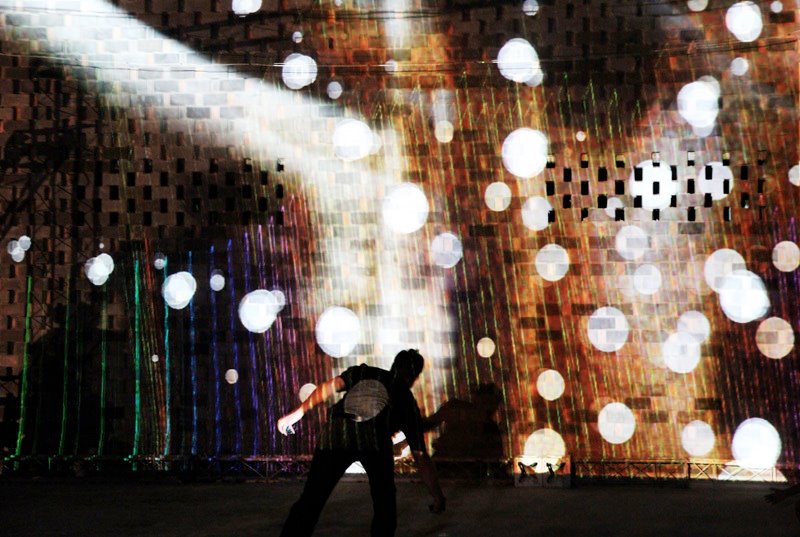
Documentation and videos at the VirtualVJ site: https://www.telebody.ws/VirtualDJ/virtualvj/virtualvj.html
3D tracking, sound, and programming: Steve Gibson
Visuals and programming: Stefan Arisona
History
- November 2011 - Duncan of Jordanstone College of Art & Design, Dundee, Scotland. Invited Exhibition
- August 2011 - Jade Valley Winery, Xi’an, China. Invited Exhibition
- July 2011 - The Interactive Experience, HCI 2011, Culture Lab, Newcastle University. Refereed exhibition
- May 2011 - Culture Lab CHI party, Intersections Digital Studio, Emily Carr University of Art and Design, Vancouver. Refereed exhibition
The Exploding, Plastic and Inevitable Redux
Stefan Arisona and Steve Gibson, since 2006
Introduction
EPI Redux is re-imagining of the psychedelic classic The Exploding Plastic Inevitable, created by Andy Warhol with the Velvet Underground in the late 1960s. Rather than literally interpreting the original Warhol event, EPI Redux seeks to update psychedelia for the new millennium. Using an excess of technology the project immerses viewers in an overload of the senses and in a Gesamtkunstwerk where sound, vision, space and time coincide.
The core concept behind EPI Redux resides in both its communal nature and in its long-form. The piece has been performed by as few as two performers and as many as eleven. As all the performers are expert in their mediums this reconfiguration allows for considerable amount of spontaneity, while at the same time calling on them to apply their analytical skills in real-time. The modularity of the piece similarly allows it to take several forms and keeps the content both loose and ever-evolving. In this way the Redux is similar to the Warhol original, even as it veers dramatically from the sound and visual world of the late 60s.

Synopsis of Work (by Luc Meier, Swissnex San Francisco)
Switzerland’s Stefan Arisona and Victoria, BC’s Steve Gibson are media artists who have established a strong footing in academia while keeping their fingers on the throbbing pulse of the club scene, DJ-ing and VJ-ing underground. Grounded in the history of audiovisual tinkering, they take creative hints from illustrious forebearers to push multimedia environments into the next realm.
Arisona and Gibson joined forces in 2006 to create a digital-age reenactment of The Exploding Plastic Inevitable, the boundary-breaking multimedia show conceived in the 1960’s by Andy Warhol with the complicity of Lou Reed and his cult rock act The Velvet Underground.
A full-blown sensorium featuring giant projections of Warhol’s films, The Velvet Underground at their most dazzlingly abrasive, and dancers let loose from Warhol’s New-Yorker Factory, the original Exploding Plastic Inevitable (1966-1967) was, while it lasted, the most unique and effective discotheque environment prior to the advent of venues such as the Fillmore in San Francisco. In many ways, it remains a benchmark for all subsequent immersive multimedia shows.
Originated under the auspices of ETH Zurich’s “Digital Art Weeks” and Victoria’s “Interactive Futures”, Arisona and Gibson’s take on Warhol’s circus makes full use of digital technology and the free-flowing, associative thinking of the techno age. Armed with multiple projectors, a barrage of laptop computers and additional data-churning devices, the pair have already performed in Zurich, Victoria, Chicago, Vancouver and Shanghai.
Using custom software, live vocals, keyboards and live video processing risona and Gibson create an immersive audio-visual experience which mimics the psychedelic atmosphere of the original EPI event, while at the same time updating the audio-visual language to the 21st Century.
Resources
Photos, videos and sounds at the Exploding, Plastic & Inevitable site: https://www.telebody.ws/Exploding/
Initiators and main artists: Stefan Arisona & Steve Gibson
Guest artists: Jackson 2bears, Randy Adams, Agitpop, babel, Dyz, I send data live, Tom Kuo, Love&Olson, Marcellus, Nuthre, Scheinwerfer, Sho-b, Adam Tindale
Event History
- Oct 20 2016 - Rolex Center, EPFL, Switzerland
- Mar 17 2012 - Velvet Underground, Zouk Club, Singapore
- Nov 12 2011 - NeOn Festival Closing Party, The Reading Rooms, Dundee, UK
- Sep 5-8 2010 - DRHA 2010, Brunel University, London, UK
- Jul 3, 2010 - Digital Art Weeks 2010, Xian, China
- Nov 17 and 19, 2009 - Phoenix Square Film & Digital Media Centre, Launch Events, Leicester, UK
- Oct 17 2009 - The Institute for Converging Arts and Sciences, Launch Event, Greenwich University, London, UK
- May 29 2009 - Computational Aesthetics at the Delta Ocean Pointe Hotel, Victoria, Canada
- May 12 2009 - Cantos Society, Calgary, Canada
- Sep 18 2008 - Santa Barbara Nights Closing Party, Santa Barbara Museum of Art, Santa Barbara, CA, USA
- Aug 21, 2008 - Transdisciplinary Digital Art Canadian Book Launch, Open Space, Victoria, Canada
- Aug 1, 2008 - Swissnex San Francisco, Swiss National Day Celebrations, San Francisco, CA, USA
- May 31 2008 - ELO Visionary Landscapes Conference, Northbank Artists Gallery, Vancouver, WA, USA
- May 22 2008 - Digital Art Weeks +, Shelter Club Shanghai, Shanghai, China
- Apr 24 2008 - Conaway Centre, Columbia College Chicago, Chicago, IL, USA
- Nov 17 2007 - Interactive Futures, Open Space, Victoria, Canada.
- Jul 14 2007 - Digital Art Weeks, Zurich, Switzerland
- Oct 21 2006 - Open Space, Victoria, Canada
Pianist's Hands - Synthesis of Musical Gestures
PhD Thesis - Stefan Arisona, 2004
The process of music performance has been the same for many centuries: a work was perceived by the listening audience at the same time it was performed by one or a group of performers. The performance was not only characterised by its audible result, but also by the environment and the physical presence of the performing artists and the audience. Further, a performance was always unique in the sense that it could not be repeated in exactly the same way. The evolution of music recording technology imposed a major change to this situation and to music listening practise in general: a recorded performance suddenly became available to a dramatically increased number of listeners, and one could listen to the same performance as many times as desired. However, in a recorded music performance, the environmental characteristics and the presence of the performing artists and the audience are lost. This particularly includes the loss of musical gestures, which are an integral part of a music performance. The availability of electronic music instruments even enforces this loss of musical gestures because the previously strict connection between performer, instrument, and listener is blurred.
This thesis deals with the problem of the construction of musical gestures from a given music performance. A mathematical model where musical gestures are represented as high-dimensional parametric gesture curves is introduced. By providing a number of mathematical operations, the model provides mechanisms for the manipulation of those curves, and for the construction of complex gesture curves out of simple ones. The model is embedded into the existing performance model of mathematical music theory where a musical performance is defined as a transformation from a symbolic score space to a physical performance space.
While gestures in the symbolic domain represent abstract movements, gesture curves in the physical domain reflect “real” movements of a virtual performer, which can be rendered to a computer screen. For the correctness of the movements one has to take into account a number of constraints imposed by the performer’s body, the instrument’s geometry, and the laws of physics. In order to satisfy these constraints a shaping mechanism based on Sturm’s theorem for cubic splines is presented.
A realised software module called the PerformanceRubette provides a framework for the construction and manipulation of gesture curves for piano performance. It takes a music performance and given constraints based on a virtual hand model as input. The resulting output consists of sampled physical gesture curves describing the movements of the virtual performer’s finger tips. The software module has been used to create animated sequences of a virtual hand performing on a keyboard, for the animation of abstract objects in audio-visual performance applications, and for gesture-based sound synthesis.
Keywords: Gestural Performance, Performance Interfaces, Performance Theory, Computer Animation.
PhD Thesis: Multimedia Laboratory, University of Zurich, 2001 - 2004
PhD Candidate: Stefan Arisona
PhD Advisors: Prof. Dr. Peter Stucki and Prof. Dr. Guerino Mazzola
Surréance - A River and Five Bridges
Corebounce, in collaboration with Art Clay and Anne Faulborn, 2005
This radical, eye-and earblasting performance was realised in collaboration with Art Clay (Composition) and Anne Faulborn (Cembalo). Art Clay’s composition “A River and Five Bridges” is an electronic adaptation of André Bretons “Barrières” and asserts the affinity of rational and irrational.
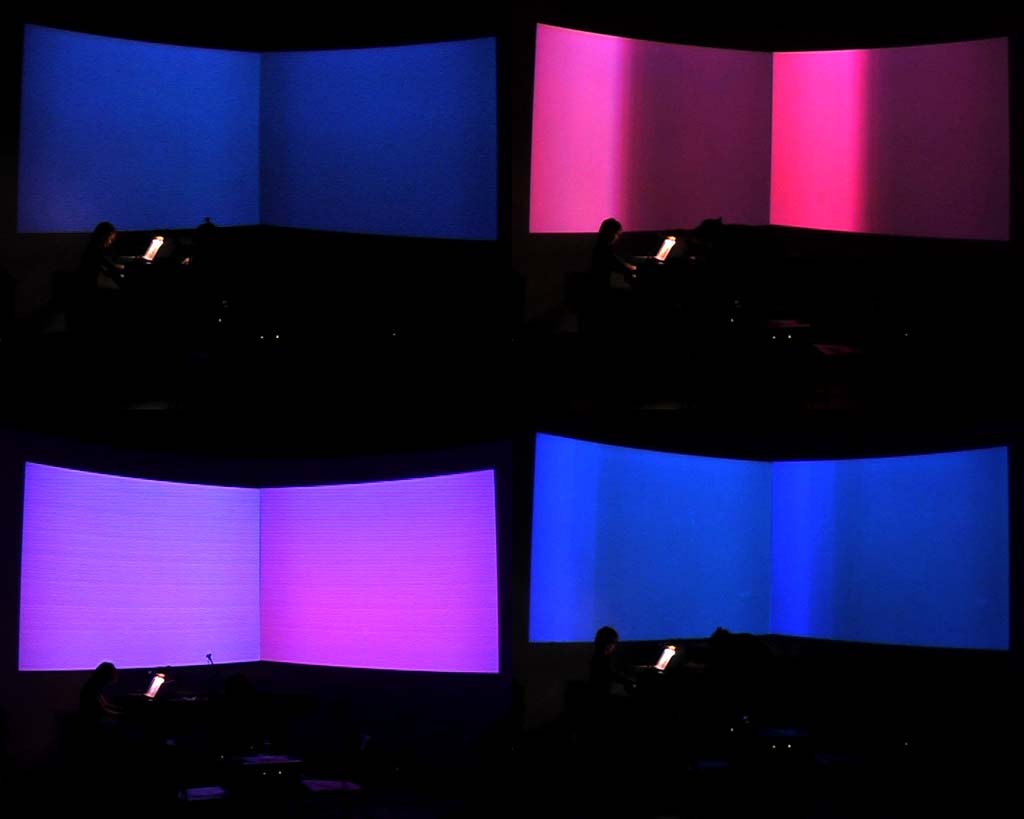
The visual composition’s interpretation, realised by Corebounce, absorbs the assertion by implementing a modulated flickering screen. The modulation function is both defined by real-time music analysis and live visual performance. The flicker colors were obtained by two cutouts from Paul Klee’s “The Twittering Machine”, one in blue tones and one in red tones.

The piece premiered at ETH Zurich’s main building dome during Digital Art Weeks 2005.
Event: Digital Art Weeks 2005
Location: ETH Zurich, Switzerland
Date: Aug 20 2005
Concept: Stefan Arisona and Art Clay
Composition: Art Clay
Programming: Stefan Arisona
Performance: Anne Faulborn, Stefan Arisona, Art Clay
The Pianist's Brainwaves
Guerino Mazzola & Corebounce, 2002
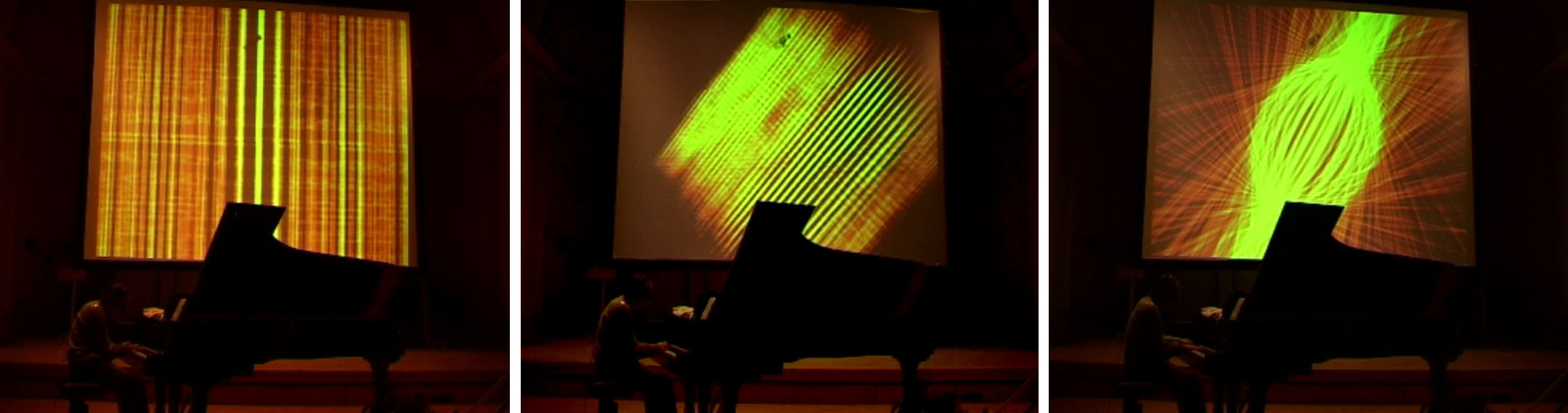
Free jazz improvisation by Guerino Mazzola over a motif of Modest Mussorgsky’s “Pictures at an Exhibition” accompanied by an expressive live visuals interpretation. Instead of using DSP music analysis, the piece employed real-time EEG (Electroencephalogram) to sense and analyse Mazzola’s brainwaves. The retrieved parameters were then mapped to for spatial distributions and movements of geometric shapes and to different color modulations.
Event: Musik - Denken - Spielen
Location: School of Music, Drama and Dance, Zurich, Switzerland
Date: Oct 26 2002
Concept and Performance: Guerino Mazzola and Stefan Arisona
Programming: Corebounce