
Tag: Publication
15 posts tagged with "Publication"
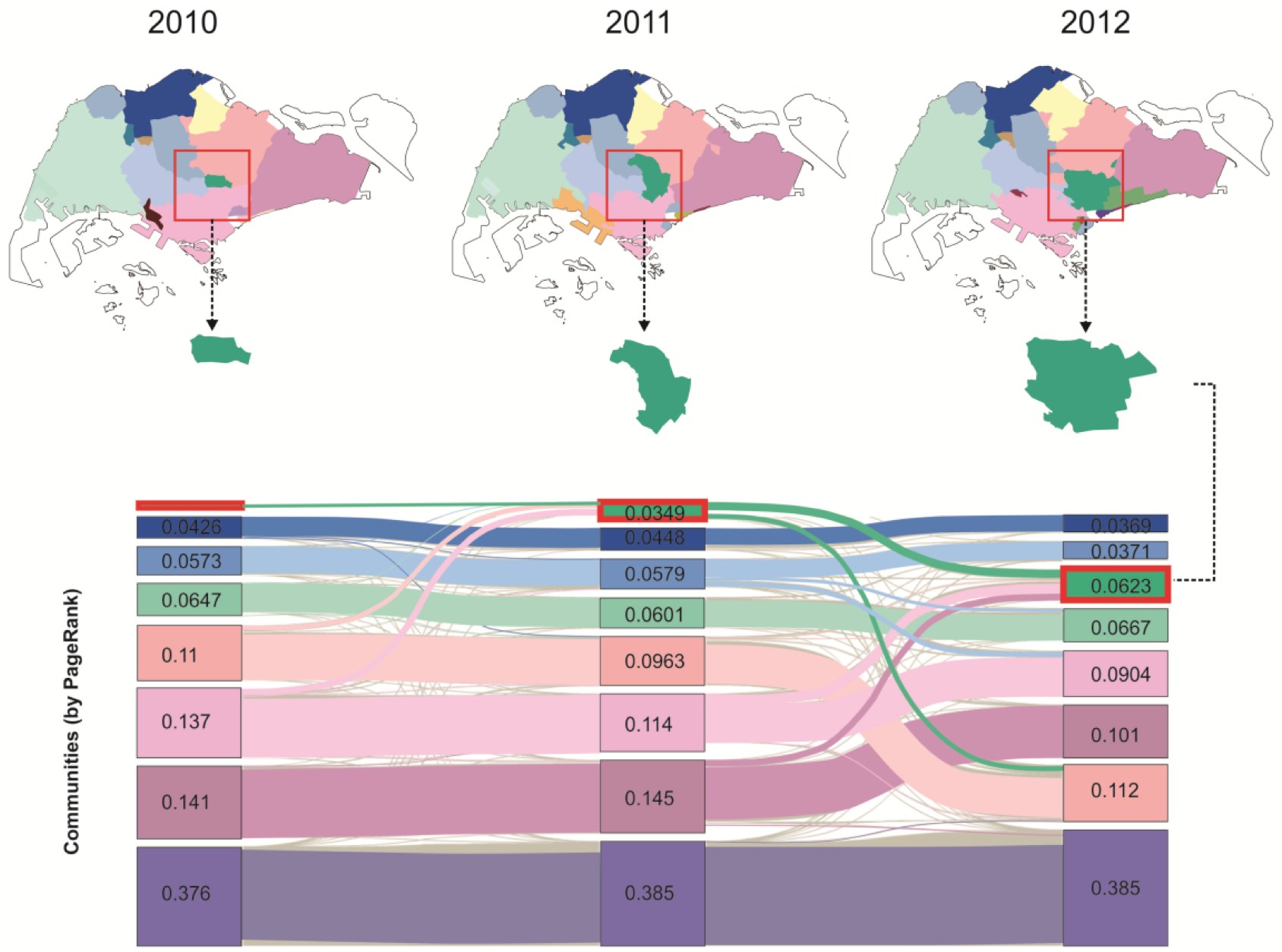
Detecting the Dynamics of Urban Structure Through Spatial Network Analysis (IJGIS 2014)
Journal: International Journal of Geographical Information Science
Authors: Chen Zhong, Stefan Arisona, Xianfeng Huang, Michael Batty, Gerhard Schmitt
Abstract: Urban spatial structure in large cities is becoming ever more complex as populations grow in size, engage in more travel, and have increasing amounts of disposable income that enable them to live more diverse lifestyles. These trends have prominent and visible effects on urban activity, and cities are becoming more polycentric in their structure as new clusters and hotspots emerge and coalesce in a wider sea of urban development. Here, we apply recent methods in network science and their generalization to spatial analysis to identify the spatial structure of city hubs, centers, and borders, which are essential elements in understanding urban interactions. We use a ‘big’ data set for Singapore from the automatic smart card fare collection system, which is available for sample periods in 2010, 2011, and 2012 to show how the changing roles and influences of local areas in the overall spatial structure of urban movement can be efficiently monitored from daily transportation. In essence, we first construct a weighted directed graph from these travel records. Each node in the graph denotes an urban area, edges denote the possibility of travel between any two areas, and the weight of edges denotes the volume of travel, which is the number of trips made. We then make use of (a) the graph properties to obtain an overall view of travel demand, (b) graph centralities for detecting urban centers and hubs, and (c) graph community structures for uncovering socioeconomic clusters defined as neighborhoods and their borders. Finally, results of this network analysis are projected back onto geographical space to reveal the spatial structure of urban movements. The revealed community structure shows a clear subdivision into different areas that separate the population’s activity space into smaller neighborhoods. The generated borders are different from existing administrative ones. By comparing the results from 3 years of data, we find that Singapore, even from such a short time series, is developing rapidly towards a polycentric urban form, where new subcenters and communities are emerging largely in line with the city’s master plan. To summarize, our approach yields important insights into urban phenomena generated by human movements. It represents a quantitative approach to urban analysis, which explicitly identifies ongoing urban transformations.
Title: Detecting the Dynamics of Urban Structure Through Spatial Network Analysis
Authors: Chen Zhong, Stefan Arisona, Xianfeng Huang, Michael Batty, Gerhard Schmitt
Journal: International Journal of Geographical Information Science
Publisher: Taylor & Francis
Year: 2014
DOI: 10.1080/13658816.2014.914521
Link: https://www.tandfonline.com/doi/abs/10.1080/13658816.2014.914521#.U8P6N1bsd8E
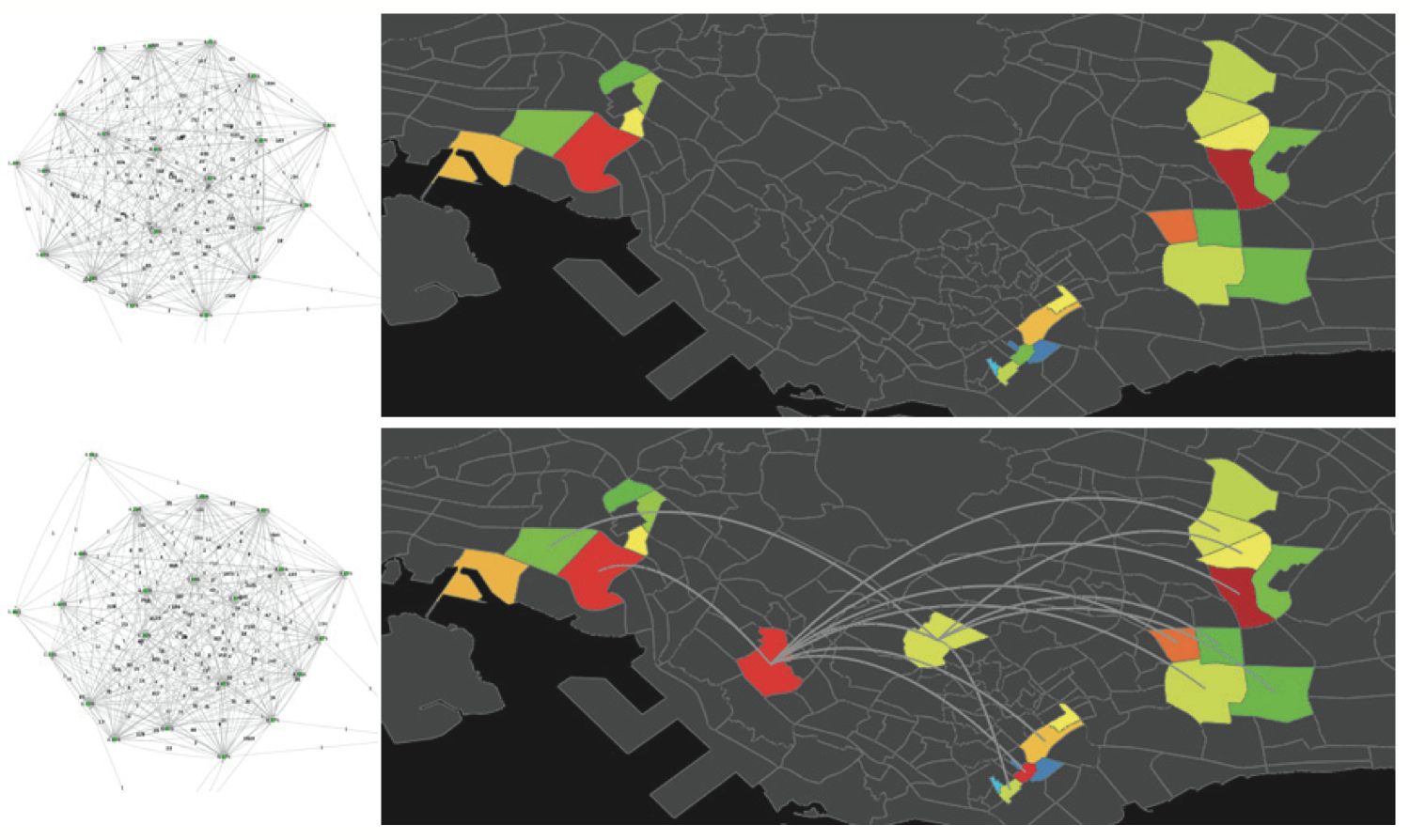
A Visual Analytics Framework for Large Transportation Datasets (CAADRIA 2014)
Conference: 19th International Conference on Computer-Aided Architectural Design Research in Asia CAADRIA 2014
Authors: Chen Zhong, Stefan Arisona, Gerhard Schmitt
Abstract: The advancement of sensor technologies makes it possible to collect large amounts of dynamic urban data. On the other hand, how to store, process, and analyze collected urban data to make them useful becomes a new challenge. To address this issue, this paper proposes a visual analytics framework, which is applied to transportation data to manage and extract information for urban studies. More specif- ically, the proposed framework has three components: (1) a geographic information system (GIS) based pipeline providing basic data processing functions; (2) a spatial network analysis that is integrated into the pipeline for extracting spatial structure of urban movement; (3) interactive operations allowing the user to explore and view the output data sets at different levels of details. Taking Singapore as a case study area, we use a sample data set from the automatic smart card fare collection system as an input to our prototype tool. The result shows the feasibility of proposed framework and analysis method. To summarize, our work shows the potential of geospatial based visual analytics tools in using ‘big’ data for urban analysis.
Award: Won best presentation award.
Title: A Visual Analytics Framework for Large Transportation Datasets
Authors: Chen Zhong, Stefan Arisona, Gerhard Schmitt
Proceedings: 19th International Conference on Computer- Aided Architectural Design Research in Asia CAADRIA 2014
Publisher: The Association for Computer-Aided Architectural Design Research in Asia (CAADRIA)
Year: 2014
Pages: 223 - 232
Link: https://cumincad.scix.net/cgi-bin/works/Show?caadria2014_014

Journal of Professional Communication: "Art/Science Hybrids"
Special Issue on Art/Science Hybrids. Journal of Professional Communication (JPC), Volume 3, Issue 2, 2013
https://digitalcommons.mcmaster.ca/jpc/
A collection of papers originally presented at Digital Art Weeks 2013 Singapore (DAW), https://www.digitalartweeks.ethz.ch/
Editor in chief: Alex Sévigny, McMaster University
Guest editors: Steve Gibson, Faculty of Art, Design and Social Science, Northumbria University, Newcastle, UK and Stefan Arisona, University of Applied Sciences and Arts Northwestern Switzerland FHNW / Future Cities Laboratory, ETH Zurich
The rise of new transdisciplinary practices in the late 20th and early 21st Centuries is striking. The gulf between art and science that has widened since the Enlightenment has now been challenged by a wide body of scholars, artists, designers and scientists. This special issue explores the concerns of emergent transdisciplinary research that seeks to re-unite the arts and sciences.
Table of Contents
Editorials
Preface to the JPC special issue on Art/Science Hybrids. Alex Sévigny
Art Into science/science into art. Steve Gibson
Iterative Emergence of Art/Science Hybrids. Stefan Arisona, Pascal Mueller, Simon Schubiger, and Matthias Specht
Commentary
Augmenting science through art. Matthias Berger
Next nature: ‘nature caused by people’. Sue Thomas
Interview
Interview with George Legrady, chair of the media arts & technology program at the University of California, Santa Barbara. Stefan Arisona
Research Articles
Art-science and verbal articulation in hyper-visual techno-culture. F. Scott Taylor
Theoretical aesthetics. Adam Tindale
Mapping art to systems thinking. Paul Goodfellow
The superhero and the DJ: Science meets design. Mikael Lindstrom, Farvash Razavi, and Nandi Novell
Social commentary through the transdisciplinary practice of audio-visual performance. Léon McCarthy
The digitization of music and the accessibility of the artist. Marius Carboni
Live programming for robotic fabrication. Jason Lim
Title: Art/Science Hybrids
Editor: Alex Sévigny
Guest Editors: Steve Gibson and Stefan Arisona
Journal: Journal of Profession Communication
Year: 2013
Volume: 3(2)
Link: https://digitalcommons.mcmaster.ca/jpc/
LEA Special Issue on Live Visuals
Special issue on Live Visuals in Leonardo Electronic Almanac (LEA), edited by Özden Sahin, Lanfranco Aceti, Steve Gibson and Stefan Arisona. https://www.leoalmanac.org/vol19-no3-live-visuals/
Live Visuals, Leonardo Electronic Almanac LEA, Volume 19 Issue 3
Key advancements in real-time graphics and video processing over the past five years have resulted in broad implications for a number of academic, research and commercial communities. They enabled interaction designers, live visualists (VJs), game programmers, and information architects to utilize the power of advanced digital technologies to model, render and effect visual information in real-time.
Real-time visuals have a profoundly different quality and therefore distinct requirements from linear visual forms such as narrative film. The use of visual elements in a live or non-linear context requires a consideration of insights and techniques from other “non-visual” practices such as music performance or human-computer interaction. The issue is organised under the general rubric of knowledge-sharing between disparate research bodies and disciplines. This allows for distinct and dispersed groups to come together in order to exchange information and techniques. A key concern is to bring a humanistic approach by considering the wider cultural context of these new developments.
The special issue explores the future of the moving image, simultaneously acknowledging and extending on recent artistic trends and technological developments.
The issue is co-edited by Özden Sahin,Lanfranco Aceti, Steve Gibson, Stefan Arisona.
Table of Contents
When Moving Images Become Alive! Introduction by Lanfranco Aceti
Revisiting Cinema: Exploring The Exhibitive Merits Of Cinema From Nickelodeon Theatre To Immersive Arenas Of Tomorrow by Brian Herczog
The Future Of Cinema: Finding New Meaning Through Live Interaction by Dominic Smith
A Flexible Approach For Synchronizing Video With Live Music by Don Ritter
Avatar Actors by Elif Ayiter
Multi-Projection Films, Almost-Cinemas And Vj Remixes: Spatial Arrangements Of Moving Image Presence by Gabriel Menotti
Machines Of The Audiovisual: The Development Of “Synthetic Audiovisual Interfaces” In The Avant-Garde Art Since The 1970s by Jihoon Kim
New Photography: A Perverse Confusion Between The Live And The Real by Kirk Woolford
Text-Mode And The Live Petscii Animations Of Raquel Meyers: Finding New Meaning Through Live Interaction by Leonard J. Paul
Outsourcing The VJ: Collaborative Visuals Using The Audience’s Smartphones by Tyler Freeman
AVVX: A Vector Graphics Tool For Audiovisual Performances by Nuno N. Correia
Architectural Projections: Changing The Perception Of Architecture With Light by Lukas Treyer, Stefan Arisona & Gerhard Schmitt
In Darwin’s Garden: Temporality and Sense of Place by Vince Dziekan, Chris Meigh-Andrews, Rowan Blaik & Alan Summers
Back To The Cross-Modal Object: A Look Back At Early Audiovisual Performance Through The Lens Of Objecthood by Atau Tanaka
Structured Spontaneity: Responsive Art Meets Classical Music In A Collaborative Performance Of Antonio Vivaldi’s Four Seasons by Yana (Ioanna) Sakellion & Yan Da
Interactive Animation Techniques In The Generation And Documentation Of Systems Art by Paul Goodfellow
Simulating Synesthesia In Spatially-Based Real-Time Audio-Visual Performance by Steve Gibson
A ‘Real Time Image Conductor’ Or A Kind Of Cinema?: Towards Live Visual Effects by Peter Richardson
Live Audio-Visual Art + First Nations Culture by Jackson 2bears
Of Minimal Materialities And Maximal Amplitudes: A Provisional Manual Of Stroboscopic Noise Performance by Jamie Allen
Visualization Technologies For Music, Dance, and Staging In Operas by Guerino Mazzola, David Walsh, Lauren Butler, Aleksey Polukeyev
How An Audio-Visual Instrument Can Foster The Sonic Experience by Adriana Sa
Gathering Audience Feedback On An Audiovisual Performance by Léon McCarthy
Choreotopology: Complex Space In Choreography With Real-Time Video by Kate Sicchio
Cinematics and Narratives: Movie Authoring & Design Focused Interaction by Mark Chavez & Yun-Ke Chang
Improvising Synesthesia: Comprovisation Of Generative Graphics And Music by Joshua B. Mailman
Title: Live Visuals
Editor: Özden Sahin
Volume Editors: Lanfranco Aceti, Steve Gibson, Stefan Arisona
Journal: Leonardo Electronic Almanac
Publisher: MIT Press
Year: 2013
Volume: 19(3)
Pages: 384
ISBN: 978-1-906897-22-2
ISSN: 1071-4391
Link: https://www.leoalmanac.org/vol19-no3-live-visuals/
Visualizing Interchange Patterns in Massive Movement Data (EuroVis 2013)
Authors: Wei Zeng, Chi-Wing Fu, Stefan Arisona, Huamin Qu
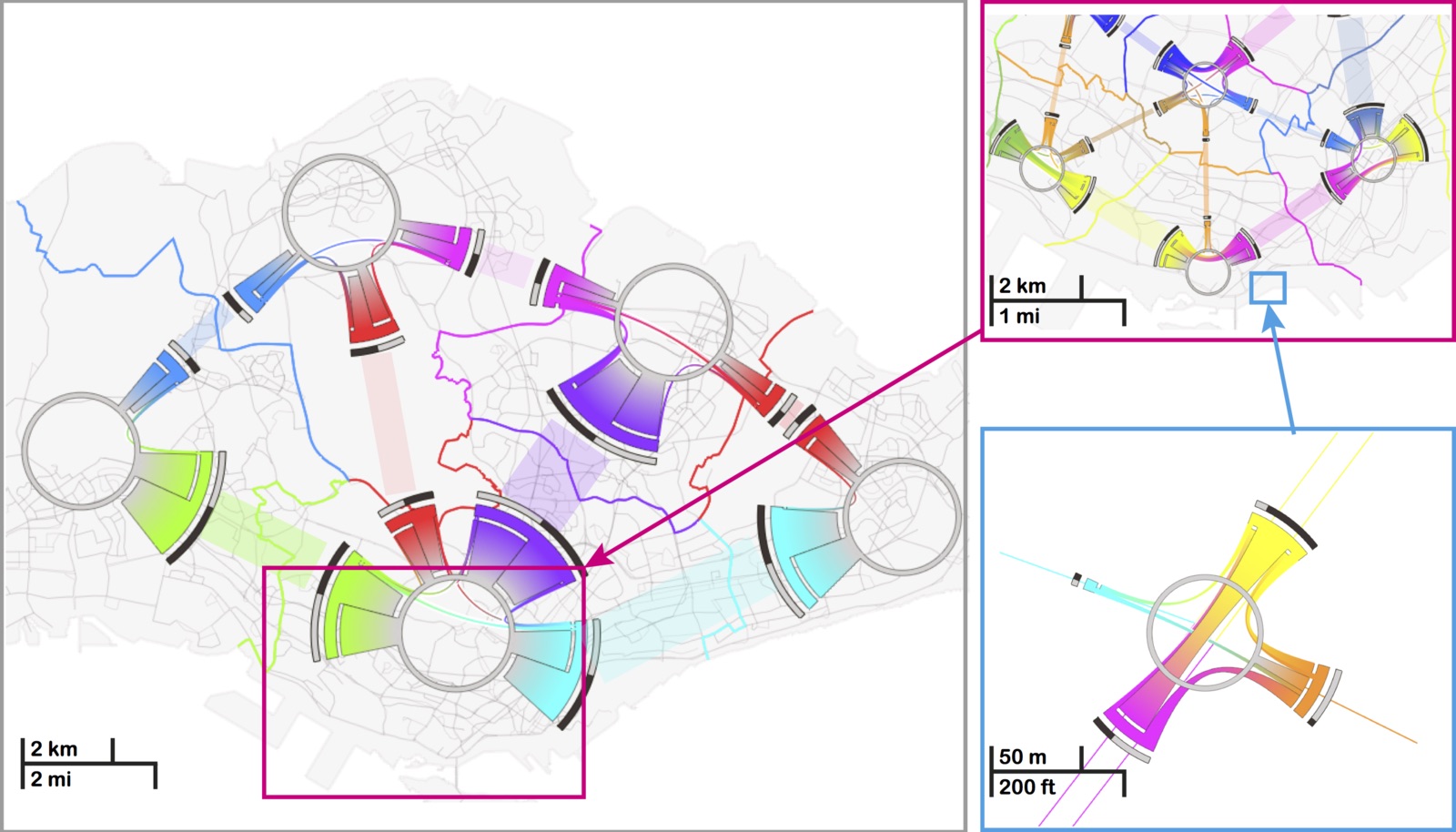
Abstract: Massive amount of movement data, such as daily trips made by millions of passengers in a city, are widely avail- able nowadays. They are a highly valuable means not only for unveiling human mobility patterns, but also for assisting transportation planning, in particular for metropolises around the world. In this paper, we focus on a novel aspect of visualizing and analyzing massive movement data, i.e., the interchange pattern, aiming at re- vealing passenger redistribution in a traffic network. We first formulate a new model of circos figure, namely the interchange circos diagram, to present interchange patterns at a junction node in a bundled fashion, and optimize the color assignments to respect the connections within and between junction nodes. Based on this, we develop a family of visual analysis techniques to help users interactively study interchange patterns in a spatiotemporal manner: 1) multi-spatial scales: from network junctions such as train stations to people flow across and between larger spatial areas; and 2) temporal changes of patterns from different times of the day. Our techniques have been applied to real movement data consisting of hundred thousands of trips, and we present also two case studies on how transportation experts worked with our interface.
https://www.youtube.com/watch?v=_QWnA1k2ZrU
Title: Visualizing Interchange Patterns in Massive Movement Data
Authors: Wei Zeng, Chi-Wing Fu, Stefan Arisona, Huamin Qu
Journal: Computer Graphics Forum
Publisher: Wiley
Year: 2013
Volume: 32(3)
Pages: 271-280
DOI: 10.1111/cgf.12114
Link: https://onlinelibrary.wiley.com/doi/10.1111/cgf.12114/abstract