
Tag: Publication
15 posts tagged with "Publication"
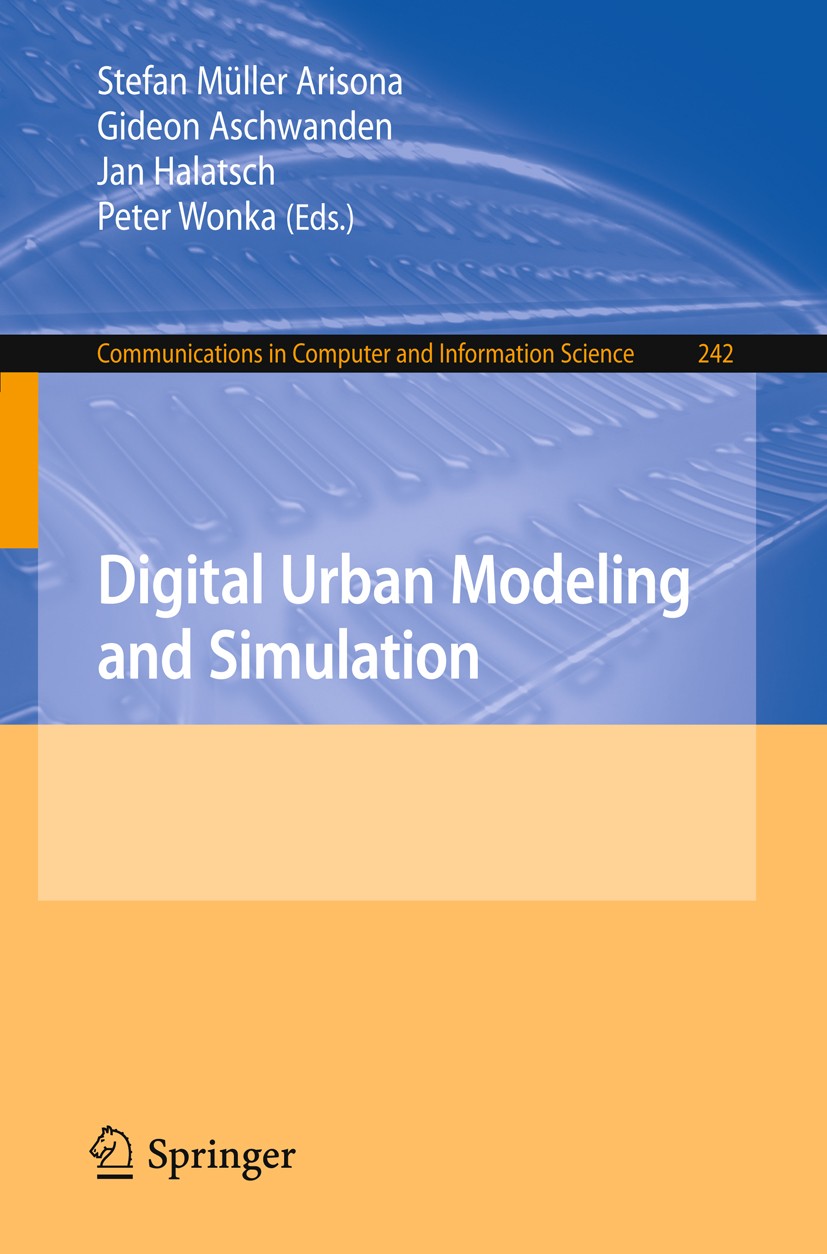
Book: Digital Urban Modeling and Simulation
Edited by Stefan Arisona, Gideon Aschwanden, Jan Halatsch, and Peter Wonka, 2012
About this Book
This book is thematically positioned at the intersections of Urban Design, Architecture, Civil Engineering and Computer Science, and it has the goal to provide specialists coming from respective fields a multi-angle overview of state-of-the-art work currently being carried out. It addresses both newcomers who wish to obtain more knowledge about this growing area of interest, as well as established researchers and practitioners who want to keep up to date. In terms of organization, the volume starts out with chapters looking at the domain at a wide-angle and then moves focus towards technical viewpoints and approaches. (Excerpt from preface by Stefan Arisona).
Contents
Part I: Introduction
A Planning Environment for the Design of Future Cities - Gerhard Schmitt
Calculating Cities - Bharat Dave
The City as a Socio-technical System: A Spatial Reformulation in the Light of the Levels Problem and the Parallel Problem - Bill Hillier
Technology-Augmented Changes in the Design and Delivery of the Built Environment - Martin Riese
Part II: Parametric Models and Information Modeling
City Induction: A Model for Formulating, Generating, and Evaluating Urban Designs - José P. Duarte, José N. Beirão, Nuno Montenegro, and Jorge Gil
Sortal Grammars for Urban Design: A Sortal Approach to Urban Data Modeling and Generation - Rudi Stouffs, José N. Beirão, and José P. Duarte
Sort Machines - Thomas Grasl and Athanassios Economou
Modeling Water Use for Sustainable Urban Design - Ramesh Krishnamurti, Tajin Biswas, and Tsung-Hsien Wang
Part III: Behavior Modeling and Simulation
Simulation Heuristics for Urban Design - Christian Derix, Åsmund Gamlesæter, Pablo Miranda, Lucy Helme, and Karl Kropf
Running Urban Microsimulations Consistently with Real-World Data - Gunnar Flötteröod and Michel Bierlaire
Urban Energy Flow Modelling: A Data-Aware Approach - Diane Perez and Darren Robinson
Interactive Large-Scale Crowd Simulation - Dinesh Manocha and Ming C. Lin
An Information Theoretical Approach to Crowd Simulation - Cagatay Turkay, Emre Koc, and Selim Balcisoy
Integrating Urban Simulation and Visualization - Daniel G. Aliaga
Part IV: Visualization, Collaboration and Interaction
Visualization and Decision Support Tools in Urban Planning - Antje Kunze, Remo Burkhard, Serge Gebhardt, and Bige Tuncer
Spatiotemporal Visualisation: A Survey and Outlook - Chen Zhong, Tao Wang, Wei Zeng, and Stefan Arisona
Multi-touch Wall Displays for Informational and Interactive Collaborative Space - Ian Vince McLoughlin, Li Ming Ang, and Wooi Boon Goh
Testing Guide Signs’ Visibility for Pedestrians in Motion by an Immersive Visual Simulation System - Ryuzo Ohno and Yohei Wada
Publication Information
Publisher: Springer, Berlin Heidelberg
Series: Communications in Computer and Information Science, Vol. 242
Editors: Arisona, S.; Aschwanden, G.; Halatsch, J.; Wonka, P.
Year: 2012
ISBN: 978-3-642-29757-1
Link: https://www.springeronline.com/978-3-642-29757-1
MetroBuzz: Interactive Visualization of Urban Transportation Data
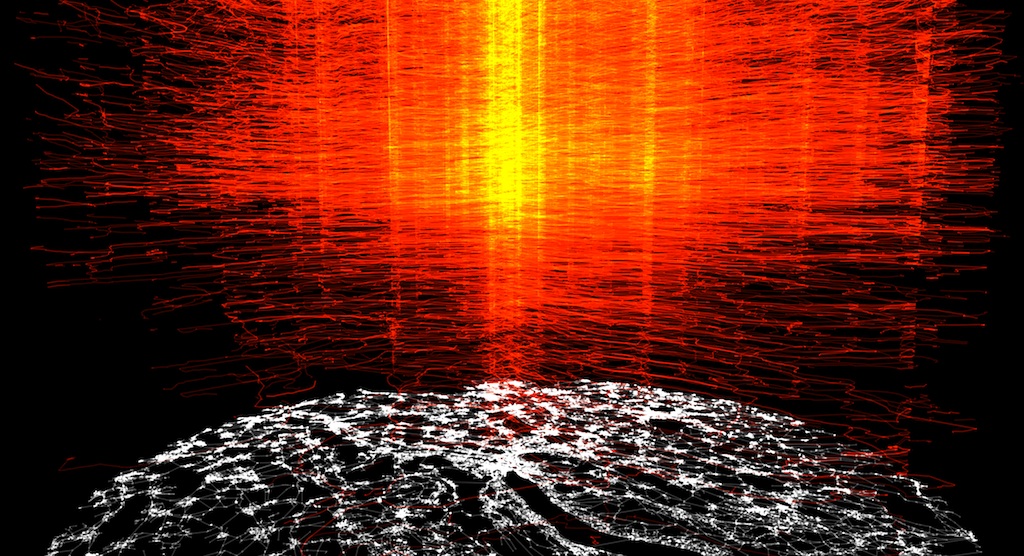
Agent based simulation tools such as MATSim and MITSIM allow us to achieve efficient and accurate predictions of crowd behavior, thereby increasing our understanding of urban systems and assist in urban planning. However, output produced by such simulation platforms are difficult to communicate to stakeholders such as government agencies and the general public due to their technical nature.
In Project Metrobuzz we present a novel and visually striking method of displaying and interacting with large amounts of simulation data in a way that is both scientifically interesting as well as understandable for a broader audience. In order to achieve this, we generalised trip origin-destination information in terms of series of line segments in 3D space that allow spatiotemporal queries to quickly retrieve relevant data. In addition, we implemented interactive tools running on mobile devices (e.g. tablets) to define such queries in an intuitive manner.
W. Zeng, C. Zhong, A. Anwar, S. Arisona, and I. V. McLoughlin. 2012. MetroBuzz: Interactive 3D Visualization of Spatiotemporal Data. International Conference on Computer and Information Sciences (ICCIS), Kuala Lumpur, Turkey, June 12 – 14.
Project: Ongoing research, software prototype.
Institution: ETH Zurich’s Future Cities Laboratory
Location: Singapore
Period: Since 2011
Concept and programming: Stefan Arisona (ETH Zurich)
Programming: Zeng Wei (NTU), Afian Anwar (MIT), Christian Schneider (ETH Zurich)
Acknowledgments: Kay Axhausen and Alex Erath of the Future Cities Laboratory’s Mobility and Transportation group for providing the base data
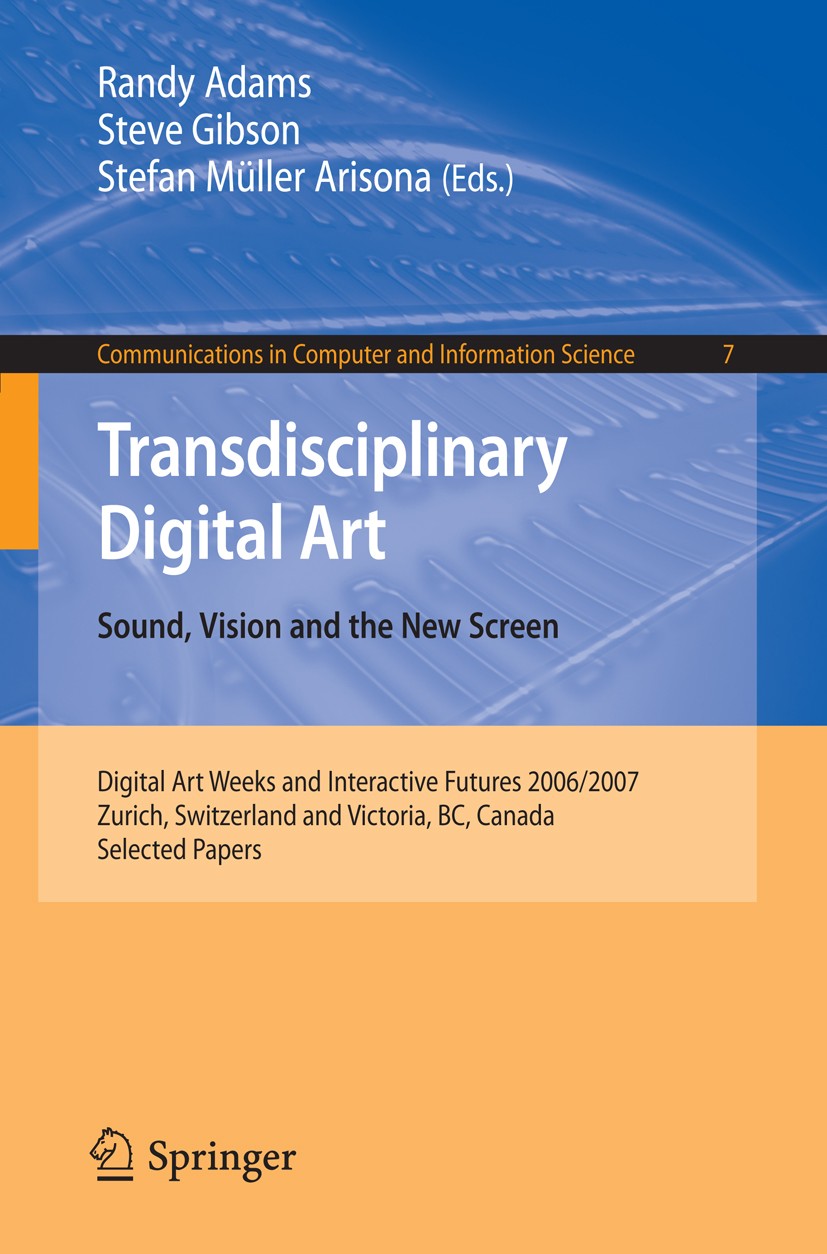
Book: Transdisciplinary Digital Art - Sound, Vision and the New Screen
Edited by Randy Adams, Steve Gibson, Stefan Arisona, 2008
This volume collects selected papers from the past two instances of Digital Art Weeks (Zurich, Switzerland) and Interactive Futures (Victoria, BC, Canada), two parallel festivals of digital media art. The work represented in Transdisciplinary Digital Art is a confirmation of the vitality and breadth of the digital arts. Collecting essays that broadly encompass the digital arts, Transdisciplinary Digital Art gives a clear overview of the on-going strength of scientific, philosophical, aesthetic and artistic research that makes digital art perhaps the defining medium of the 21st Century.
Contents
- Introduction: Why Tansdisciplinary Digital Art? - Steve Gibson
I Philosophies of the Digital
The Ethics of Aesthetics - Don Ritter
Ethical and Activist Considerations of the Technological Artwork - David Cecchetto
DIY: The Militant Embrace of Technology - Marcin Ramocki
Tuning in Rorschach Maps - Will Pappenheimer
Body Degree Zero: Anatomy of an Interactive Performance - Alan Dunning, Paul Woodrow
Artificial, Natural, Historical - Acoustic Ambiguities in Documentary Film - Julian Rohrhuber
The Colour of Time (God is a lobster and other forbidden bodies) - Johnny Golding
Behind the Screen: Installations from the Interactive Future - Ted Hiebert
II Digital Literacies
Transliteracy and New Media - Sue Thomas
Digital Archiving and “The New Screen” - John F. Barber
Digital Fiction: From the Page to the Screen - Kate Pullinger
The Present [Future] of Electronic Literature - Dene Grigar
Transient Passages: The Work of Peter Horvath - Celina Jeffery
III Multimedia Composition and Performance
Visceral Mobile Music Systems - Atau Tanaka
Designing a System for Supporting the Process of Making a Video Sequence - Shigeki Amitani, Ernest Edmonds
Video Game Audio Prototyping with Half-Life 2 - Leonard J. Paul
Computer-assisted Content Editing Techniques for Live Multimedia Performance - Stefan Arisona, Pascal Müller, Simon Schubiger-Banz, Matthias Specht
Computational Audiovisual Composition Using Lua - Wesley Smith, Graham Wakefield
Interrelation: Sound-Transformation and Re-Mixing in Real-Time - Hannes Raffaseder, Martin Parker
Functors for Music: The Rubato Composer System - Guerino Mazzola, Gerard Milmeister, Karim Morsy, Florian Thalmann
Inventing Malleable Scores: From Paper to Screen Based Scores - Arthur Clay
Glimmer: Creating New Connections - Jason Freeman
Variations on Variations - Daniel Peter Biro
IV Interfaces and Expression
Gestures, Interfaces and Other Secrets of the Stage - Eva Sjuve
Beyond the Threshold: The Dynamic Interface as Permeable Technology - Carolyn Guertin
CoPuppet: Collaborative Interaction in Virtual Puppetry - Paolo Bottoni, Stefano Faralli, Anna Labella, Alessio Malizia, Mario Pierro, Semi Ryu
Experiments in Digital Puppetry: Video Hybrids in Apples Quartz Composer - Ian Grant
Formalized and Non-Formalized Expression in Musical Interfaces - Cornelius Poepel
V Digital Space: Design, Movement, and Robotics
Interactive Spaces - Jeffrey Huang, Muriel Waldvogel
From Electric Devices to Electronic Behaviour - Stijn Ossevoort
Scentsory Design: Scent Whisper and Fashion Fluidics - Jennifer Tillotson
Advances in Expressive Animation in the Interactive Performance of a Butoh Dance - Jürg Gutknecht, Irena Kulka, Paul Lucowicz, Tom Stricker
Anthropocentrism and the Staging of Robots - Louis-Philippe Demers, Jana Horakova
VI Digital Performance in Urban Spaces
Imaging Place: Globalization and Immersive Media - John Craig Freeman
About… Software, Surveillance, Scariness, Subjectivity (and SVEN) - Amy Alexander
The NOVA Display System - Simon Schubiger-Banz, Martina Eberle
Four Wheel Drift - Petra Watson, Julie Andreyev
Publication Information
Collection: Digital Art Weeks and Interactive Futures 2006/2007, Zürich, Switzerland and Victoria, BC, Canada, Selected Papers
Publisher: Springer, Berlin Heidelberg
Series: Communications in Computer and Information Science , Vol. 7
Editors: Adams, Randy; Gibson, Steve; Arisona, Stefan (Eds.)
Year: 2008
ISBN: 978-3-540-79485-1
Link: https://www.springerlink.com/content/978-3-540-79485-1
The Digital Marionette
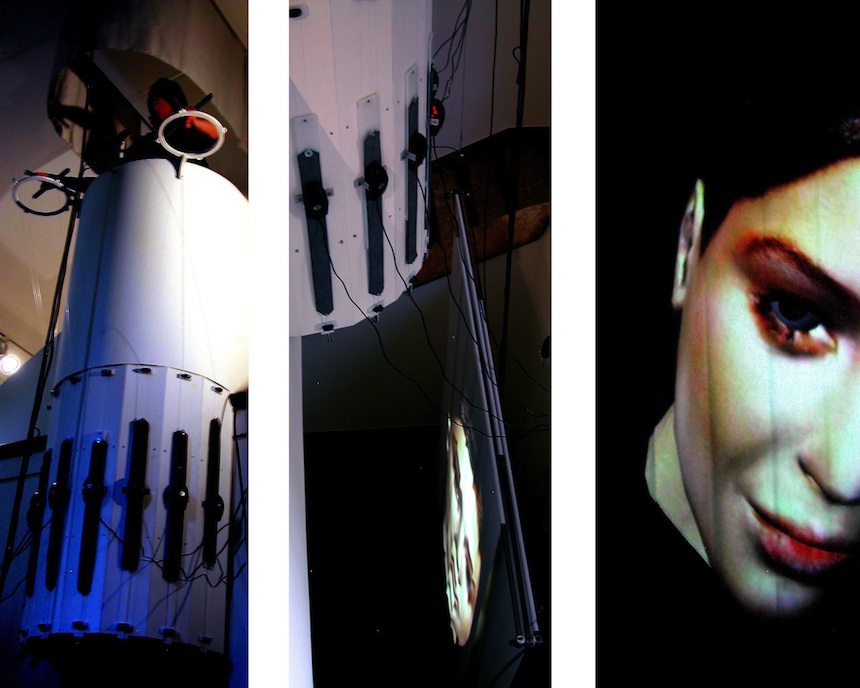
The interactive installation Digital Marionette impressively shows the audience the look and feel of a puppet in the multimedia era: The nicely dressed wooden marionette is replaced by a Lara Croft - like character; the traditional strings attached to puppet control handles emerge into a network of computer cables. The installation is currently exhibited at the Ars Electronica Center in Linz.
The installation consists of a projection of a digital face, which can be controlled by the visitors. The puppet can be made talking via speech input, and the classical puppet controls serve as controllers for head direction and face emotions, such as joy, anger, or sadness. The whole artistic concept was designed and realised in an interdisciplinary manner, incorporating art historical facts about marionettes, the architectural space, interaction design, and state of the art research results from computer graphics and speech recognition.
Concept
The translation from old to new, from analogue to digital, takes place via the most popular computer input device: the mouse. The puppet control handles are attached to sliding strips of mousepads and eight computer mice track movements of the individual strings. This approach is at the same time efficient, low-cost and easily understandable by the non-expert visitor. Speech input is realised via speech recognition, where the recognised phonemes are mapped to a set of facial expressions and visemes.
Exhibition at Museum Bellerive, Zurich, Switzerland, 2004
The first exhibition of the Marionette was realised in 2004 by the Corebounce Art Collective in cooperation with Christian Iten (interface realisation), Swisscom Innovations (Swiss-German voice recognition), and ETH Zürich (real-time face animation), and Eva Afuhs and Sergio Cavero (Curators, Museum Bellerive, Zürich).
Exhibition at Ars Electronica Centre, Linz, Austria, 2006 - 2008
An augmented permanent version of the installation was presented in the entrace hall of the world-famous Ars Electronica Center in Linz. It was realised by the Corebounce Art Collective with technical support from Gerhard Grafinger of the Ars Electronica Center. Furthermore we thank Ellen Fethke, Gerold Hofstadler and Nicoletta Blacher of Ars Electronica; and Jürg Gutknecht and Luc Van Gool of ETH Zürich.
Bellerive Installation Video
3D Concept Video
Additional Information
Exhibition: Museum Bellerive
Location: Zurich, Switzerland
Period: Jun 11 - Sep 12 2004
Exhibition: Ars Electronic Centre
Location: Linz, Austria
Period: Sep 2006 - Sep 2008
Concept and realisation: Corebounce Art Collective (Pascal Mueller, Stefan Arisona, Simon Schubiger, Matthias Specht)
Pianist's Hands - Synthesis of Musical Gestures
PhD Thesis - Stefan Arisona, 2004
The process of music performance has been the same for many centuries: a work was perceived by the listening audience at the same time it was performed by one or a group of performers. The performance was not only characterised by its audible result, but also by the environment and the physical presence of the performing artists and the audience. Further, a performance was always unique in the sense that it could not be repeated in exactly the same way. The evolution of music recording technology imposed a major change to this situation and to music listening practise in general: a recorded performance suddenly became available to a dramatically increased number of listeners, and one could listen to the same performance as many times as desired. However, in a recorded music performance, the environmental characteristics and the presence of the performing artists and the audience are lost. This particularly includes the loss of musical gestures, which are an integral part of a music performance. The availability of electronic music instruments even enforces this loss of musical gestures because the previously strict connection between performer, instrument, and listener is blurred.
This thesis deals with the problem of the construction of musical gestures from a given music performance. A mathematical model where musical gestures are represented as high-dimensional parametric gesture curves is introduced. By providing a number of mathematical operations, the model provides mechanisms for the manipulation of those curves, and for the construction of complex gesture curves out of simple ones. The model is embedded into the existing performance model of mathematical music theory where a musical performance is defined as a transformation from a symbolic score space to a physical performance space.
While gestures in the symbolic domain represent abstract movements, gesture curves in the physical domain reflect “real” movements of a virtual performer, which can be rendered to a computer screen. For the correctness of the movements one has to take into account a number of constraints imposed by the performer’s body, the instrument’s geometry, and the laws of physics. In order to satisfy these constraints a shaping mechanism based on Sturm’s theorem for cubic splines is presented.
A realised software module called the PerformanceRubette provides a framework for the construction and manipulation of gesture curves for piano performance. It takes a music performance and given constraints based on a virtual hand model as input. The resulting output consists of sampled physical gesture curves describing the movements of the virtual performer’s finger tips. The software module has been used to create animated sequences of a virtual hand performing on a keyboard, for the animation of abstract objects in audio-visual performance applications, and for gesture-based sound synthesis.
Keywords: Gestural Performance, Performance Interfaces, Performance Theory, Computer Animation.
PhD Thesis: Multimedia Laboratory, University of Zurich, 2001 - 2004
PhD Candidate: Stefan Arisona
PhD Advisors: Prof. Dr. Peter Stucki and Prof. Dr. Guerino Mazzola