
Tag: Simon Schubiger
13 posts tagged with "Simon Schubiger"
The Exploding, Plastic and Inevitable @ Zouk's Velvet Underground
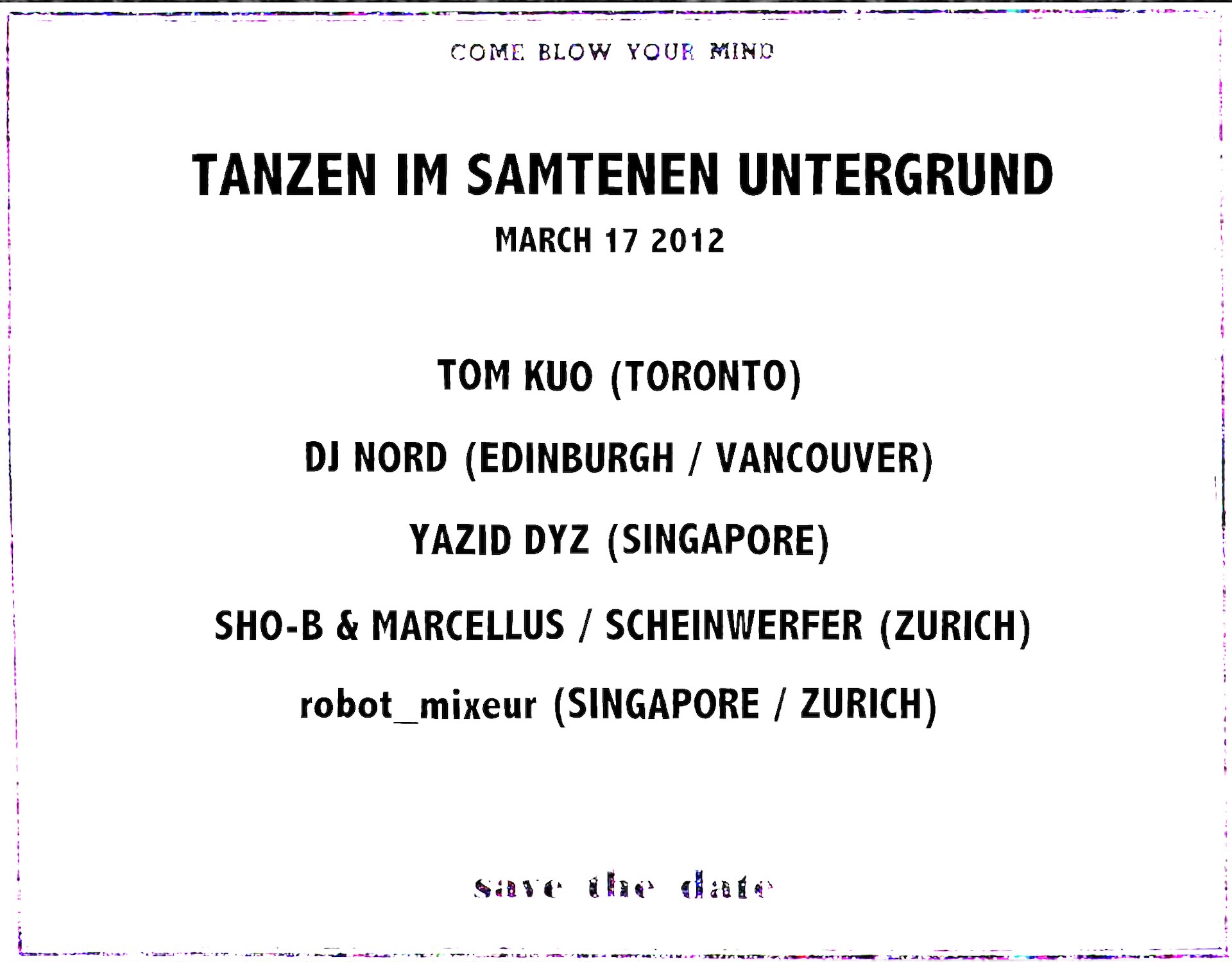
Save the date for the night: The EPI is coming to Singapore, and which space would be a better match than Velvet Underground? My friends Tom Kuo (Toronto), Steve Gibson (Vancouver / Edinburgh), Dyz (Singapore), Marcellus & Sho-B (Zurich) and I will be spinning and flickering all night…
Corebounce & Scheinwerfer
Pascal Müller, Stefan Arisona, Simon Schubiger, Matthias Specht, since 2001
Corebounce is a collective of artists and scientists with the common goal of mediating between arts, science, and technology. We maintain a number of new media projects and our own multimedia software research platform, Soundium. We are organised as a non-profit association and collaborate with a number of partners from education, in particular with ETH Zürich, and industry.
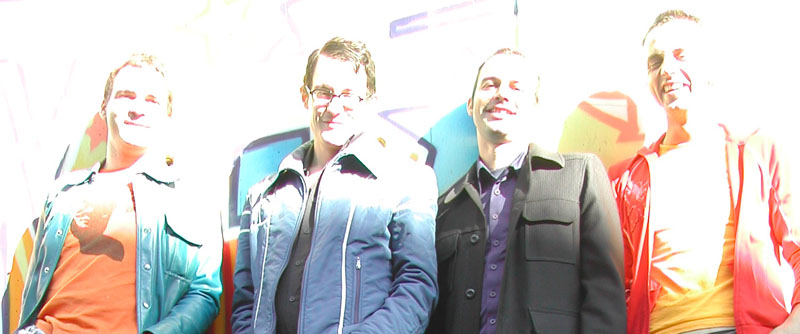
We regularly tour as the Scheinwerfer Live Visuals Collective, where we create the visual experience at various electronic music events since 2001. Our live-composited and sound-driven visuals are designed to emphasise the theme of the event as well as taking into account the architectural framework. Not coincidentally, we have been labelled as “Club Scientists”: As stated above, our performances are deeply influenced by the momentary state of the Soundium research software platform. At the same time research is typically induced by specfic artistic performance goals.
Scheinwerfer has performed at some of the coolest locations around the globe, supporting world-class DJs and musicians like Jeff Mills, Rush, Miss Kittin, Dave Clarke, Josh Wink, Mouse on Marks, Jimi Tenor and many more.
The Exploding, Plastic and Inevitable Redux
Stefan Arisona and Steve Gibson, since 2006
Introduction
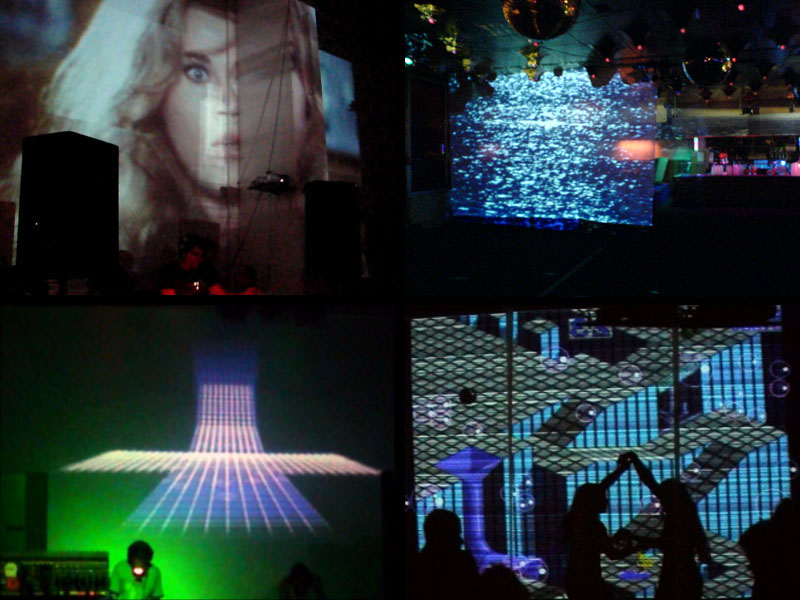
EPI Redux is re-imagining of the psychedelic classic The Exploding Plastic Inevitable, created by Andy Warhol with the Velvet Underground in the late 1960s. Rather than literally interpreting the original Warhol event, EPI Redux seeks to update psychedelia for the new millennium. Using an excess of technology the project immerses viewers in an overload of the senses and in a Gesamtkunstwerk where sound, vision, space and time coincide.
The core concept behind EPI Redux resides in both its communal nature and in its long-form. The piece has been performed by as few as two performers and as many as eleven. As all the performers are expert in their mediums this reconfiguration allows for considerable amount of spontaneity, while at the same time calling on them to apply their analytical skills in real-time. The modularity of the piece similarly allows it to take several forms and keeps the content both loose and ever-evolving. In this way the Redux is similar to the Warhol original, even as it veers dramatically from the sound and visual world of the late 60s.

Synopsis of Work (by Luc Meier, Swissnex San Francisco)
Switzerland’s Stefan Arisona and Victoria, BC’s Steve Gibson are media artists who have established a strong footing in academia while keeping their fingers on the throbbing pulse of the club scene, DJ-ing and VJ-ing underground. Grounded in the history of audiovisual tinkering, they take creative hints from illustrious forebearers to push multimedia environments into the next realm.
Arisona and Gibson joined forces in 2006 to create a digital-age reenactment of The Exploding Plastic Inevitable, the boundary-breaking multimedia show conceived in the 1960’s by Andy Warhol with the complicity of Lou Reed and his cult rock act The Velvet Underground.
A full-blown sensorium featuring giant projections of Warhol’s films, The Velvet Underground at their most dazzlingly abrasive, and dancers let loose from Warhol’s New-Yorker Factory, the original Exploding Plastic Inevitable (1966-1967) was, while it lasted, the most unique and effective discotheque environment prior to the advent of venues such as the Fillmore in San Francisco. In many ways, it remains a benchmark for all subsequent immersive multimedia shows.
Originated under the auspices of ETH Zurich’s “Digital Art Weeks” and Victoria’s “Interactive Futures”, Arisona and Gibson’s take on Warhol’s circus makes full use of digital technology and the free-flowing, associative thinking of the techno age. Armed with multiple projectors, a barrage of laptop computers and additional data-churning devices, the pair have already performed in Zurich, Victoria, Chicago, Vancouver and Shanghai.
Using custom software, live vocals, keyboards and live video processing risona and Gibson create an immersive audio-visual experience which mimics the psychedelic atmosphere of the original EPI event, while at the same time updating the audio-visual language to the 21st Century.
Resources
Photos, videos and sounds at the Exploding, Plastic & Inevitable site: https://www.telebody.ws/Exploding/
Initiators and main artists: Stefan Arisona & Steve Gibson
Guest artists: Jackson 2bears, Randy Adams, Agitpop, babel, Dyz, I send data live, Tom Kuo, Love&Olson, Marcellus, Nuthre, Scheinwerfer, Sho-b, Adam Tindale
Event History
- Oct 20 2016 - Rolex Center, EPFL, Switzerland
- Mar 17 2012 - Velvet Underground, Zouk Club, Singapore
- Nov 12 2011 - NeOn Festival Closing Party, The Reading Rooms, Dundee, UK
- Sep 5-8 2010 - DRHA 2010, Brunel University, London, UK
- Jul 3, 2010 - Digital Art Weeks 2010, Xian, China
- Nov 17 and 19, 2009 - Phoenix Square Film & Digital Media Centre, Launch Events, Leicester, UK
- Oct 17 2009 - The Institute for Converging Arts and Sciences, Launch Event, Greenwich University, London, UK
- May 29 2009 - Computational Aesthetics at the Delta Ocean Pointe Hotel, Victoria, Canada
- May 12 2009 - Cantos Society, Calgary, Canada
- Sep 18 2008 - Santa Barbara Nights Closing Party, Santa Barbara Museum of Art, Santa Barbara, CA, USA
- Aug 21, 2008 - Transdisciplinary Digital Art Canadian Book Launch, Open Space, Victoria, Canada
- Aug 1, 2008 - Swissnex San Francisco, Swiss National Day Celebrations, San Francisco, CA, USA
- May 31 2008 - ELO Visionary Landscapes Conference, Northbank Artists Gallery, Vancouver, WA, USA
- May 22 2008 - Digital Art Weeks +, Shelter Club Shanghai, Shanghai, China
- Apr 24 2008 - Conaway Centre, Columbia College Chicago, Chicago, IL, USA
- Nov 17 2007 - Interactive Futures, Open Space, Victoria, Canada.
- Jul 14 2007 - Digital Art Weeks, Zurich, Switzerland
- Oct 21 2006 - Open Space, Victoria, Canada
Mobile Systems Architectures Lecture
The lecture “Mobile Systems Architectures 1 & 2”, taught at the Computer Systems Institute of ETH Zurich in 2006 and 2007, was realised in collaboration with Swisscom, and took an integral approach to mobile computing from a “systems view”. The course was targeted at master programme students with an interest in mobile applications and systems design. Its goal was to provide in-depth knowledge of all architectural aspects of today’s mobile systems and to prepare the students for taking a leading role in designing and implementing tomorrow’s mobile systems and application models. The course will directly benefited from the Institute’s internationally acknowledged research competence in systems construction. Swisscom contributed its competence and technicall skills as leading mobile network operator.
Important Information
Please Note: Simon left Swisscom Innovations in July 2007 and I left ETH Zurich’s Computer Systems Institute in September 2007, and the course has been suspended with the end of summer term 2007. We thank all students that participated and contributed to the course.
The slides are available here, but please be aware that they have not been updated since 2007 and some chapters are outdated (e.g. who’s interested in Symbian nowadays?). However, much of the conceptual and historical content is still valid. If you are interested in the original PowerPoint files for your own course, please get in touch! We will be happy to give permission to use the material as long as the origin and authorship are mentioned.
Organisation & Lecturers
Dr. Stefan Arisona, Computer Systems Institute, Department of Computer Science, ETH Zürich Dr. Simon Schubiger, Swisscom Innovations
Slide Download
Mobile Systems Architectures 1: https://robotized.arisona.ch/doc/msa/msa_1_slides.zip Mobile Systems Architectures 2: https://robotized.arisona.ch/doc/msa/msa_2_slides.zip Industry Compact Course: https://robotized.arisona.ch/doc/msa/cc_slides.zip
Course Materials: MSA I
General Information
Title: Mobile Systems Architectures I / Mobile System-Architekturen I
Number: 251-0279-00L
Schedule: Winter Term 2006/2007, Wednesdays 9 - 11 (Lecture) and 11 - 12 (Exercises)
Location: IFW C42
Credit Points (ECTS): 5
Language: German, English (if requested)
Enrollment: Web
Description
The lecture Mobile Systems Architectures I & II, which is realised in collaboration with Swisscom, takes an integral approach to mobile computing from a “systems view”. The course is targeted at master programme students with an interest in mobile applications and systems design. Its goal is to provide in-depth knowledge of all architectural aspects of today’s mobile systems and to prepare the students for taking a leading role in designing and implementing tomorrow’s mobile systems and application models.
The first part of the course, Mobile Systems Architectures I [251-0279-00], focuses on mobile devices, their operating systems, and how these devices communicate locally. In addtion, we will present various, widely used SPIs (System Programming Interfaces), APIs (Application Programming Interfaces), and corresponding development environments, which are essential for the mobile service and application designer/developer.
The material is presented in a top-down approach, starting with the high-level Java 2 Microedition. Then various operating systems are presented (Symbian, Windows CE). Typical mobile hardware will be presented in terms of a case study of TI’s OMAP platform. Local communication is covered by NFC, IrDA, Bluetooth, the AT commands and OBEX. At the end of the course we will present Sync ML and OMA DM, which can be seen as the crossing point to remote communication, covered in Mobile Systems Architectures II (Summer term 2007).
It is our intent to present the course in a broad manner. At the same time, we will provide in-depth information at certain points, typically in terms of accompaning lab exercises. The practical application of the presented material is regarded as an integral part of the course, and successful solutions will be rewarded in terms of final credit point accreditation.
Principal Objectives
Introduction to the foundations of mobile systems architectures with particular focus on mobile end devices such as hand phones and PDAs, their operating systems and local communication capabilities. Become acquainted with development and simulation environments. Realisation of practical application examples.
Requirements
- Basic knowledge on operating systems and computer networks.
- Basic C++ and Java programming skills.
Efficiency Control and Examination
- All exercises (except those marked as optional) have to be completed and sent to the assistant by email (deadlines are given below). Please build groups of two.
- End-term oral examination.
Schedule, Handouts and Exercises
25.10.2006: Introduction and Development Environments
Exercise 1: J2ME Development Environment Setup. Optional.
01.11.2006: Developing for Mobile Devices: Java 2 Microedition (1)
Exercise 2: J2ME Address Book.
08.11.2006: Developing for Mobile Devices: Java 2 Microedition (2)
Exercise 2: J2ME Address Book (continued).
15.11.2006: Developing for Mobile Devices: Symbian (1)
Exercise 3: Native Hello World. Optional.
22.11.2006: Developing for Mobile Devices: Symbian (2)
Exercise 4: Native Extended Address Book.
29.11.2006: Developing for Mobile Devices: MSHELL & Python
Exercise 4: Native Extended Address Book (continued).
06.12.2006: Developing for Mobile Devices: Windows CE
Exercise 4: Native Extended Address Book (continued).
13.12.2006: Mobile Linux / Mobile Device Hardware: OMAP
Exercise 4: Native Extended Address Book (continued)
20.12.2006: Local Communication: NFC
Exercise 5: NFC Exercise. Deadline: 10.01.2007
3.01.2007: Local Communication: IrDA
Exercise 6: Dump Analysis. Deadline: 17.01.2007
10.01.2007: Local Communication: IrDA, IrCOMM, OBEX
17.01.2007: Local Communication: AT Commands
Exercise 7: Address Book + OBEX. Deadline: 31.01.2007
24.01.2007: Local Communication: Bluetooth 1
31.01.2007: Local Communication: Bluetooth 2. Summary.
Course Materials MSA II
General Information
Title: Mobile Systems Architectures II / Mobile System-Architekturen II
Number: 251-0280-00
Schedule: Summer Term 2007, Wednesdays 9 - 11 (Lecture) and 11 - 12 (Exercises)
Location: IFW B42
Credit Points (ECTS): 5
Language: German, English (if requested)
Enrollment: Web
Description
The lecture Mobile Systems Architectures I & II, which is realised in collaboration with Swisscom, takes an integral approach to mobile computing from a “systems view”. The course is targeted at master programme students with an interest in mobile applications and systems design. Its goal is to provide in-depth knowledge of all architectural aspects of today’s mobile systems and to prepare the students for taking a leading role in designing and implementing tomorrow’s mobile systems and application models.
The second part of the course, Mobile Systems Architectures II [251-0280-00], focuses on current and upcoming remote communication capabilities of mobile devices, cellular networks and mobile service infrastructures. The course does not deal with low level wireless communication theory, which is well covered by other courses offered at ETHZ.
Starting point will be currently deployed (2G) GSM networks, including GSM voice, SMS, MMS and WAP services. We will cover 2.5G and 2.75G packet based services like GPRS and EDGE. As next step we will introduce UMTS with a side glance at other 3G standards. In addition, an introduction WLAN and WiMAX technologies is given. At another level, the course will present techniques for the successful design of mobile client server applications.
It is our intent to present the course in a broad manner. At the same time, we will provide in-depth information at certain points, typically in terms of accompaning lab exercises. The practical application of the presented material is regarded as an integral part of the course, and successful solutions will be rewarded in terms of final credit point accreditation.
Principal Objectives
Introduction to the foundations of mobile systems architectures with particular focus on currently deployed and future remote communication technologies and mobile application services. Become acquainted with development and simulation environments. Realisation of practical application examples.
Requirements
- Basic knowledge on operating systems and computer networks.
- Basic C++ and Java programming skills.
- Mobile Systems Architectures I recommended but not required.
Efficiency Control and Examination
- All exercises (except those marked as optional) have to be completed and sent to the assistant by email (deadlines are given below). Please build groups of two.
- End-term oral examination.
Schedule, Handouts and Exercises
21.03.2007: Introduction
28.03.2007: GSM: Introduction and Protocols
04.04.2007: GSM Protocols continued
11.04.2007: GSM Voice/Data and SMS
Exercise 1 is at the end of the slides. Deadline is 24.4.2007
18.04.2007: GPRS & EDGE
25.04.2007: UMTS 1
02.05.2007: UMTS 2
CMDA Link: https://www.dpunkt.de/mobile/code/cdma.html
09.05.2007: Location Based Services
Exercise 2 is at the end of the slides. Deadline is 24.5.2007
16.05.2007: End-to-End Application Design I
23.05.2007: Emission (Guest Lecturer)
30.05.2007: End-to-End Application Design II
06.06.2007: Outlook Asia (Japan / South Korea) (Guest Lecturer)
13.06.2007: HDSPA / VOIP / CASE STUDIES
Note: The case studies are presented in the lecture only.
20.06.2007: Alternatives: WLAN, WIMAX, VoIP… (Guest Lecturer)
SQEAK - Real-time Multiuser Interaction Using Cellphones
This research project explored one approach to providing mobile phone users with a simple low cost real-time user interface allowing them to control highly interactive public space applications involving a single user or a large number of simultaneous users.
In order to sense accurately the real-time hand movement gestures of mobile phone users, the method uses miniature accelerometers that send the orientation signals over the network’s audio channel to a central computer for signal processing and application delivery. This affords that there is minimal delay, minimal connection protocol incompatibility and minimal mobile phone type or version discrimination. Without the need for mass user compliance, large numbers of users could begin to control public space cultural and entertainment applications using simple gesture movements.
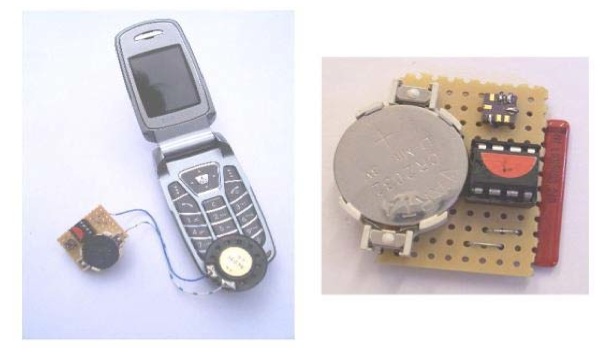
D. Majoe, S. Schubiger-Banz, A. Clay, and S. Arisona. 2007. SQEAK: A Mobile Multi Platform Phone and Networks Gesture Sensor. In: Proceedings of the Second International Conference on Pervasive Computing and Applications (ICPCA07). Birmingham, UK, July 26 - 27.
Research: Project carried out at ETH Zurich
Location: ETH Zurich, Switzerland
Timeframe: 2006 - 2007
Realisation: Stefan Arisona, Simon Schubiger, Dennis Majoe, Art Clay
Collaborator: Swisscom Innovations