
Tag: Software
16 posts tagged with "Software"
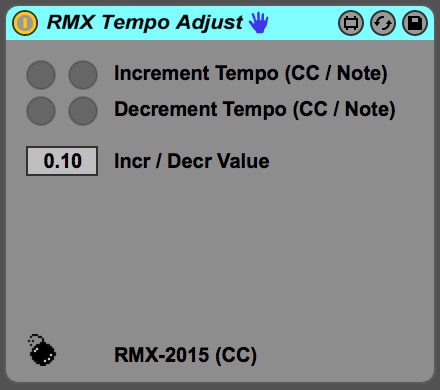
RMX Tempo Adjust (Max for Live Utility)
I quickly coded a small utility for Ableton Live that allows mapping of controller buttons / keyboard keys to increment / decrement tempo. There are other ways to achieve this (e.g. https://www.ableton.com/en/articles/tempo-mapping-buttons/), however for those with M4L this seems easier and more flexible. It’s obviously not very generic, but can easily be modified to increment / decrement other live parameters in a similar way. Just drop it on an empty MIDI track and map the two buttons.
Download it for free here: https://www.maxforlive.com/library/device/2986/rmx-tempo-adjust
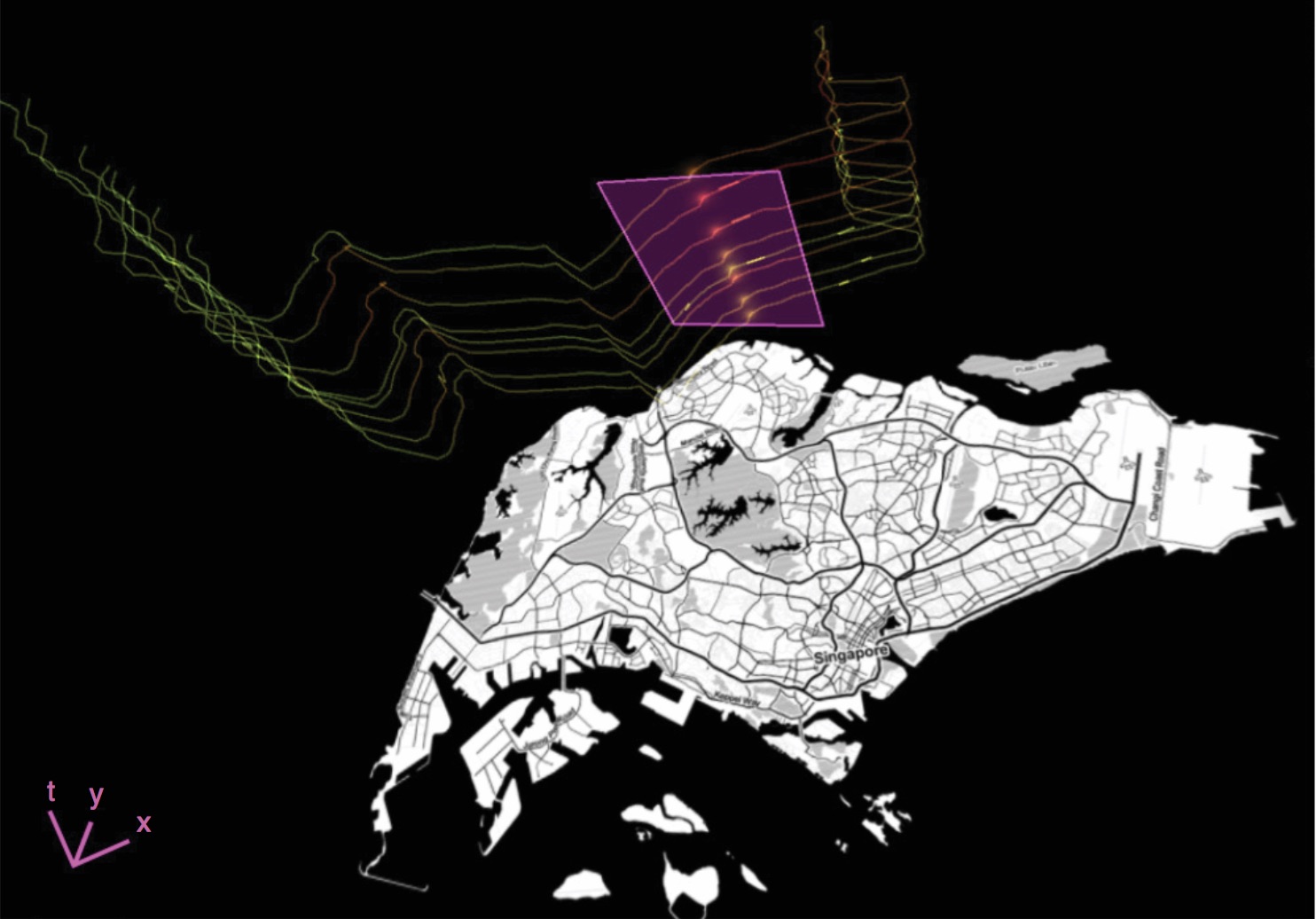
Time–Space Diagram Revisited (TRR 2442)
Journal: Transportation Research Record: Journal of the Transportation Research Board.
Authors: Afian Anwar, Zeng Wei, Stefan Arisona
Abstract: Widely used in the design and analysis of transportation systems, time-space diagrams were developed in an era of data scarcity, when it was necessary to obtain data by means of driver logs, human observ- ers, and aerial photographs. This paper shows how time-space diagrams remain relevant today, in an era of data abundance. An application efficiently encodes the trajectories of bus GPS data in a time-space cube and uses simple geometric methods to calculate and to visualize the headways and separation of buses on a bus route. These methods are discussed in detail. How they can be used as the basis of a software package that monitors performance measures for a variety of applications is explored.
Title: Time-Space Diagram Revisited
Authors: Afian Anwar, Wei Zeng, Stefan Arisona
Journal: TRR
Publisher: TRB
Volume: 2442
Year: 2014
Pages: 1 - 7
Link: https://dx.doi.org/10.3141/2442-01
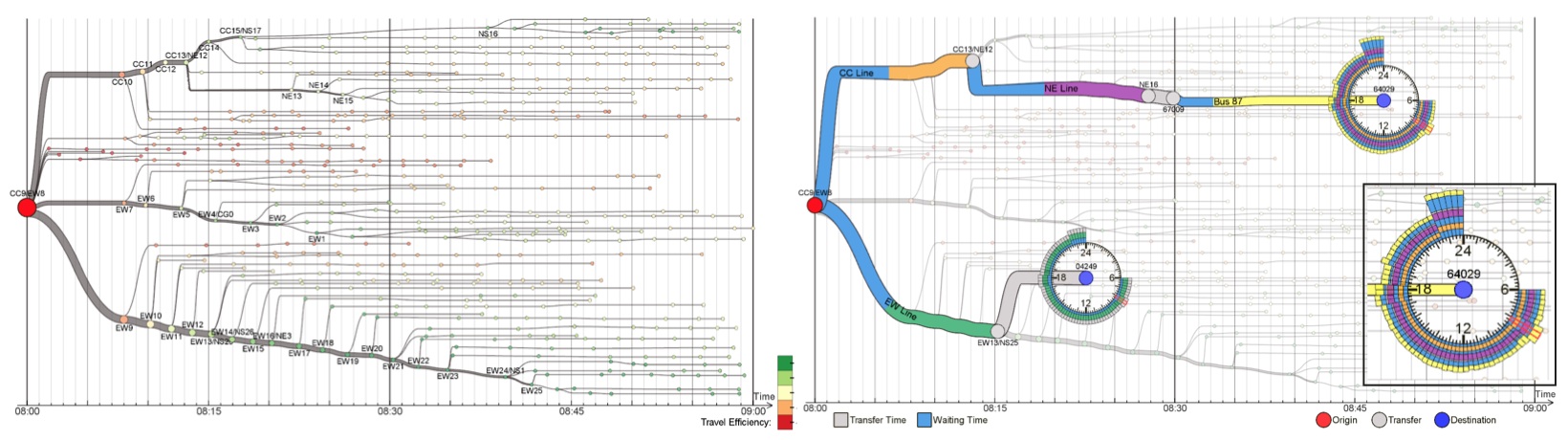
Visualizing Mobility of Public Transportation System (TVCG/VAST)
Journal: IEEE Transactions on Visualization and Computer Graphics (TVCG).
Conference: IEEE Visual Analytics Science and Technology (VAST) 2014.
Authors: Wei Zeng, Chi-Wing Fu, Stefan Arisona, Alexander Erath, Huamin Qu
Abstract: Public transportation systems (PTSs) play an important role in modern cities, providing shared/massive transportation services that are essential for the general public. However, due to their increasing complexity, designing effective methods to visualize and explore PTS is highly challenging. Most existing techniques employ network visualization methods and focus on showing the network topology across stops while ignoring various mobility-related factors such as riding time, transfer time, waiting time, and round-the-clock patterns. This work aims to visualize and explore passenger mobility in a PTS with a family of analytical tasks based on inputs from transportation researchers. After exploring different design alternatives, we come up with an integrated solution with three visualization modules: isochrone map view for geographical information, isotime flow map view for effective temporal information comparison and manipulation, and OD-pair journey view for detailed visual analysis of mobility factors along routes between specific origin-destination pairs. The isotime flow map linearizes a flow map into a parallel isoline representation, maximizing the visualization of mobility information along the horizontal time axis while presenting clear and smooth pathways from origin to destinations. Moreover, we devise several interactive visual query methods for users to easily explore the dynamics of PTS mobility over space and time. Lastly, we also construct a PTS mobility model from millions of real passenger trajectories, and evaluate our visualization techniques with assorted case studies with the transportation researchers.
https://www.youtube.com/watch?v=Q95c8PpneT8
Title: Visualizing Mobility of Public Transportation System
Authors: Wei Zeng, Chi-Wing Fu, Stefan Arisona, Alexander Erath, Huamin Qu
Journal: IEEE TVCG
Publisher: IEEE
Volume: 20(12)
Year: 2014
Pages: 1833 - 1842
Link: https://dx.doi.org/10.1109/TVCG.2014.2346893
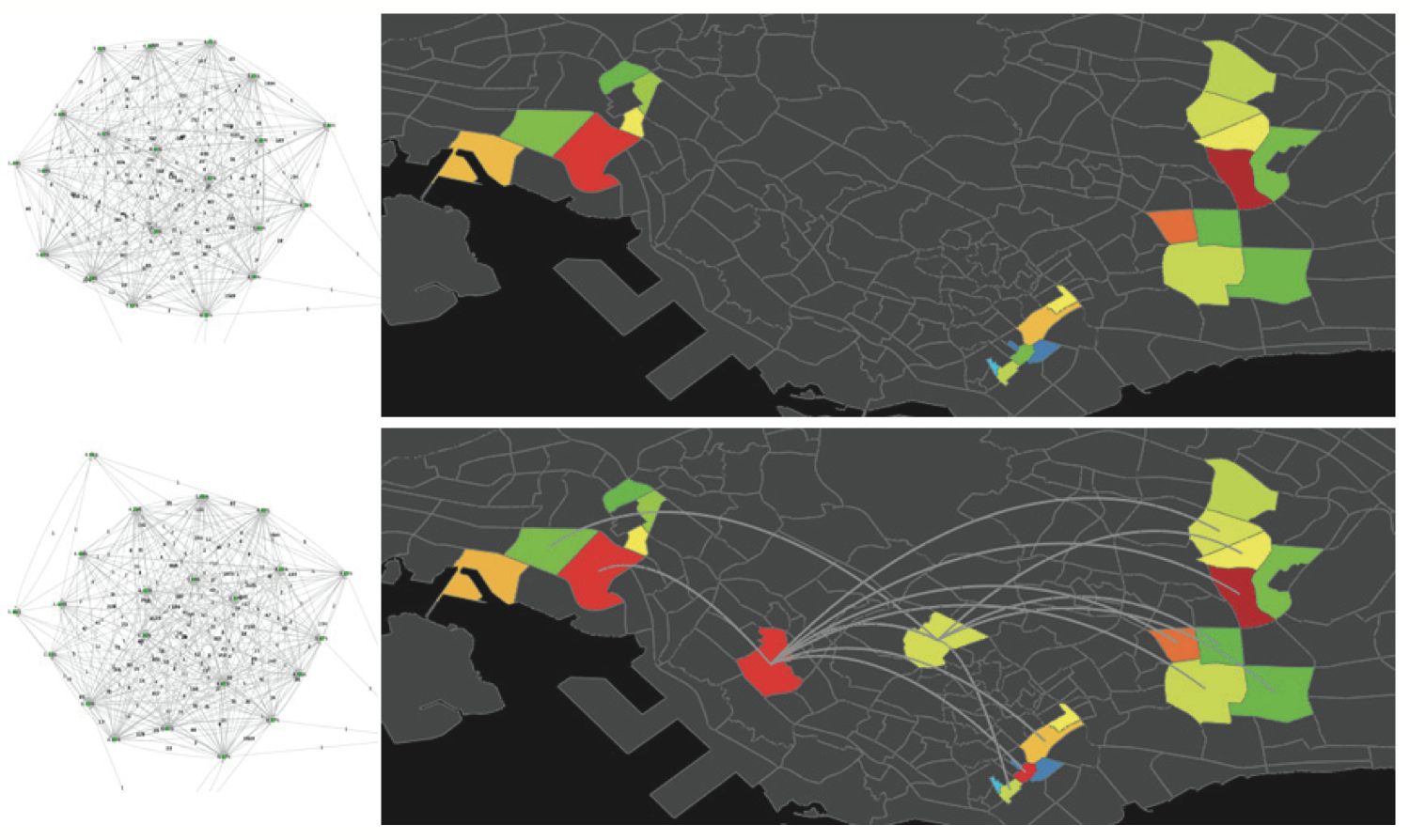
A Visual Analytics Framework for Large Transportation Datasets (CAADRIA 2014)
Conference: 19th International Conference on Computer-Aided Architectural Design Research in Asia CAADRIA 2014
Authors: Chen Zhong, Stefan Arisona, Gerhard Schmitt
Abstract: The advancement of sensor technologies makes it possible to collect large amounts of dynamic urban data. On the other hand, how to store, process, and analyze collected urban data to make them useful becomes a new challenge. To address this issue, this paper proposes a visual analytics framework, which is applied to transportation data to manage and extract information for urban studies. More specif- ically, the proposed framework has three components: (1) a geographic information system (GIS) based pipeline providing basic data processing functions; (2) a spatial network analysis that is integrated into the pipeline for extracting spatial structure of urban movement; (3) interactive operations allowing the user to explore and view the output data sets at different levels of details. Taking Singapore as a case study area, we use a sample data set from the automatic smart card fare collection system as an input to our prototype tool. The result shows the feasibility of proposed framework and analysis method. To summarize, our work shows the potential of geospatial based visual analytics tools in using ‘big’ data for urban analysis.
Award: Won best presentation award.
Title: A Visual Analytics Framework for Large Transportation Datasets
Authors: Chen Zhong, Stefan Arisona, Gerhard Schmitt
Proceedings: 19th International Conference on Computer- Aided Architectural Design Research in Asia CAADRIA 2014
Publisher: The Association for Computer-Aided Architectural Design Research in Asia (CAADRIA)
Year: 2014
Pages: 223 - 232
Link: https://cumincad.scix.net/cgi-bin/works/Show?caadria2014_014
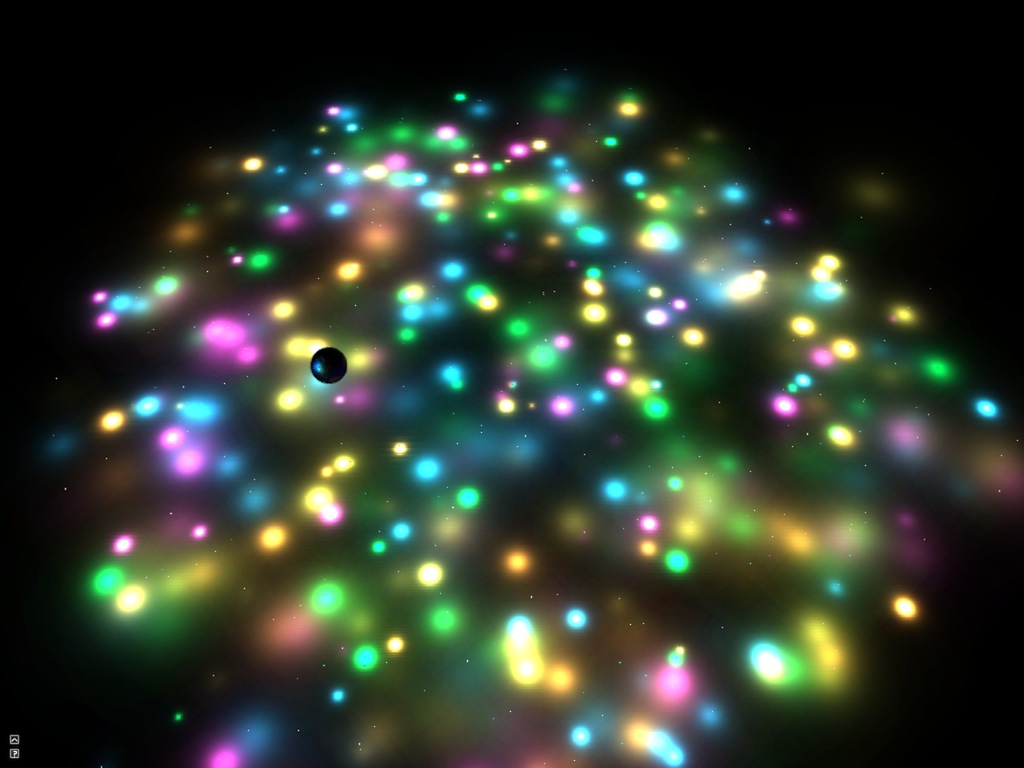
Cinder Deferred Renderer
Cinder application for deferred rendering experiments (lighing, shadow mapping, SSAO), available on Github at https://github.com/arisona/cinder_deferred_renderer
Forked from original code by Anthony Scavarelli at https://github.com/PlumCantaloupe/Cinder-Deferred-Renderer
Thanks to Anthony and the contributors this code is based on.
Original code ported to c++11 and optimized / fixed a couple of things, plus some new features/controls.
This code is based on a deferred renderer for point lights and screen space ambient occlusion (SSAO), including shadow mapping.