
Tag: Soundium
6 posts tagged with "Soundium"
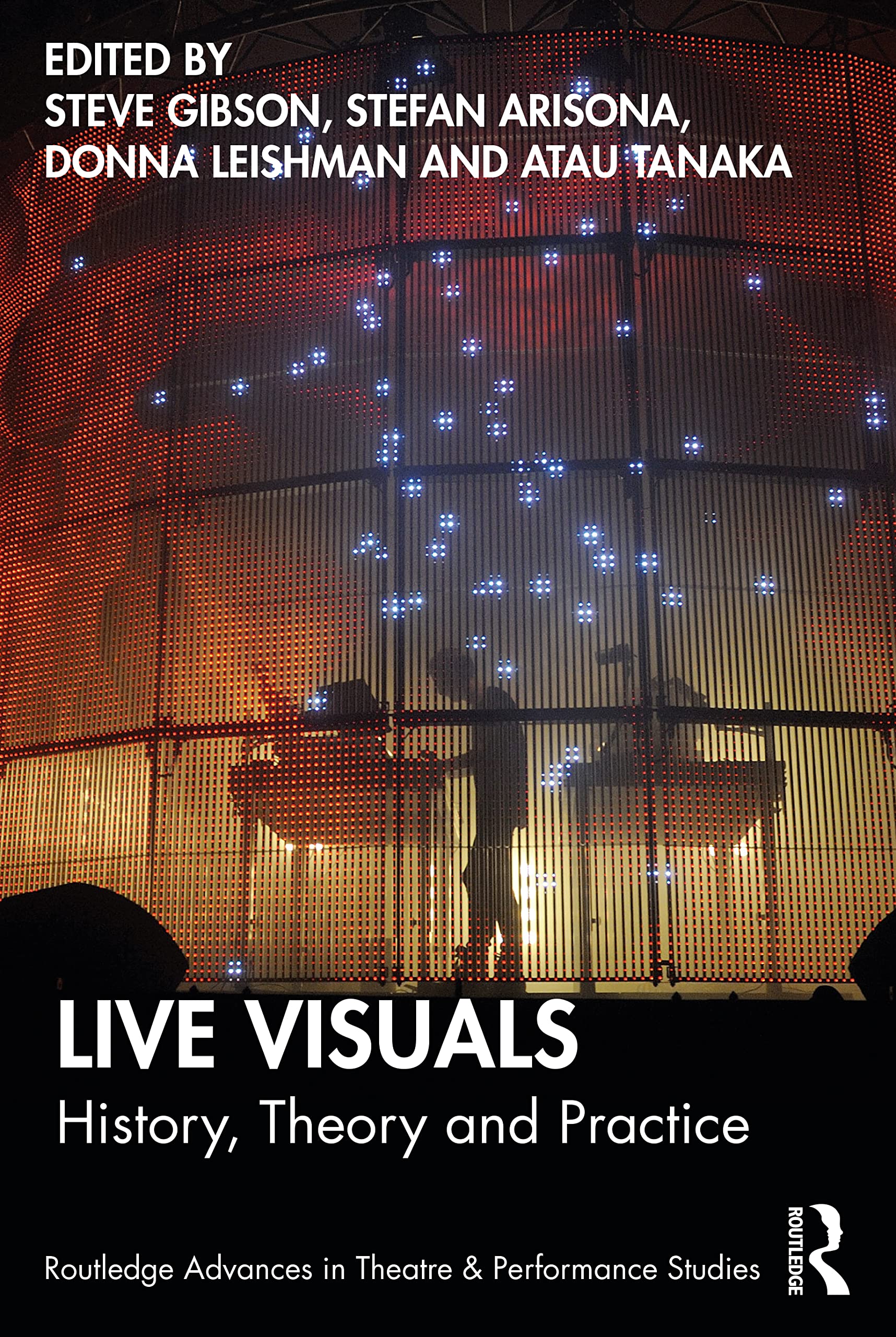
Book: Live Visuals - History, Theory, Practice
Edited by: Steve Gibson, Stefan Arisona, Donna Leishman and Atau Tanaka, 2022
From the publisher:
This volume surveys the key histories, theories and practice of artists, musicians, filmmakers, designers, architects and technologists that have worked and continue to work with visual material in real time.
Covering a wide historical period from Pythagoras’s mathematics of music and colour in ancient Greece, to Castel’s ocular harpsichord in the 18th century, to the visual music of the mid-20th century, to the liquid light shows of the 1960s and finally to the virtual reality and projection mapping of the present moment, Live Visuals is both an overarching history of real-time visuals and audio-visual art and a crucial source for understanding the various theories about audio-visual synchronization. With the inclusion of an overview of various forms of contemporary practice in Live Visuals culture – from VJing to immersive environments, architecture to design – Live Visuals also presents the key ideas of practitioners who work with the visual in a live context.
This book will appeal to a wide range of scholars, students, artists, designers and enthusiasts. It will particularly interest VJs, DJs, electronic musicians, filmmakers, interaction designers and technologists.
Read more on the publishers site: https://www.routledge.com/Live-Visuals-History-Theory-Practice/Gibson-Arisona-Leishman-Tanaka/p/book/9781032252681
robot_mixeur
‘robot_mixeur’ is my alter ego when performing as visualist and DJ. As a DJ, I usually mix elements from minimal techno, tech house and techno into driving soundscapes and pushing beats. As a visualist (or VJ), I am using the self-coded software Soundium/Decklight as performance environment for live video editing and 3D content generation.
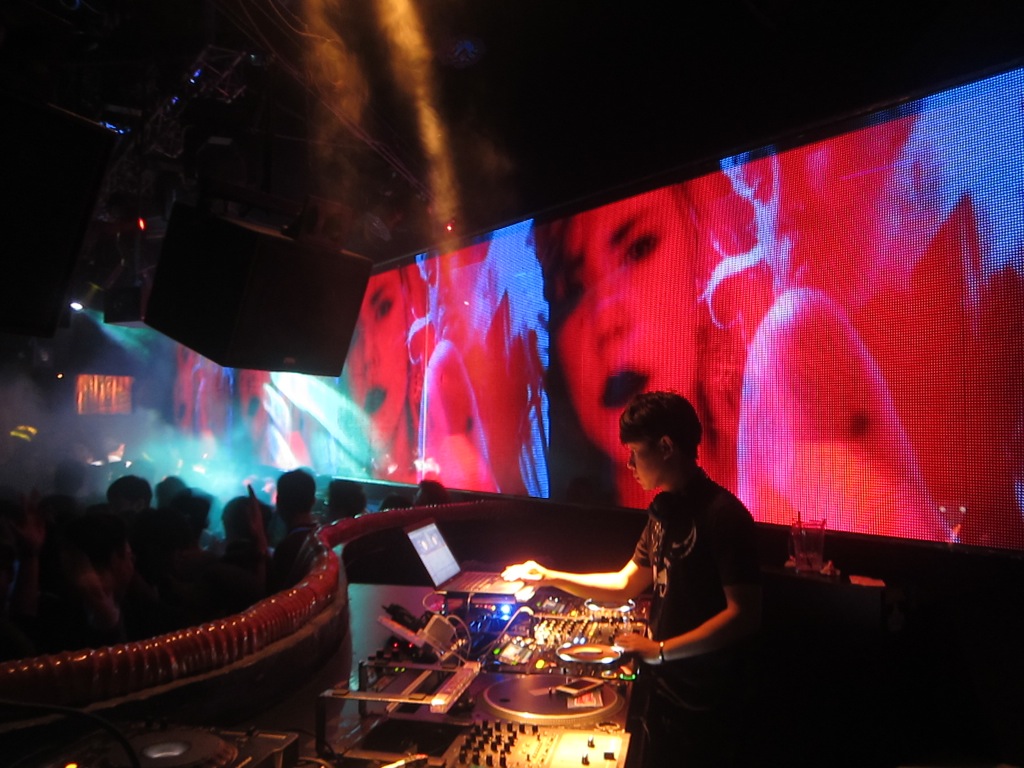
Numerous performances at around the globe include Zouk Singapore (DJ Mag World Top 5 in 2012), Shanghai’s legendary Shelter, Zurich’s EWZ, Victoria’s Open Space, or Chicago’s Conway Centre. Below is a short excerpt from a DJ / Visuals performance at the Art Stage Singapore opening party at Zouk’s Velvet Underground in January 2012.
https://www.mixcloud.com/robot_mixeur/poursuite-du-bonheur/
https://www.mixcloud.com/robot_mixeur/shadows-live-at-shelter-shanghai-2008/
Various DJ sets, photos and more videos are available at Steve Gibson’s EPI site.
Corebounce & Scheinwerfer
Pascal Müller, Stefan Arisona, Simon Schubiger, Matthias Specht, since 2001
Corebounce is a collective of artists and scientists with the common goal of mediating between arts, science, and technology. We maintain a number of new media projects and our own multimedia software research platform, Soundium. We are organised as a non-profit association and collaborate with a number of partners from education, in particular with ETH Zürich, and industry.
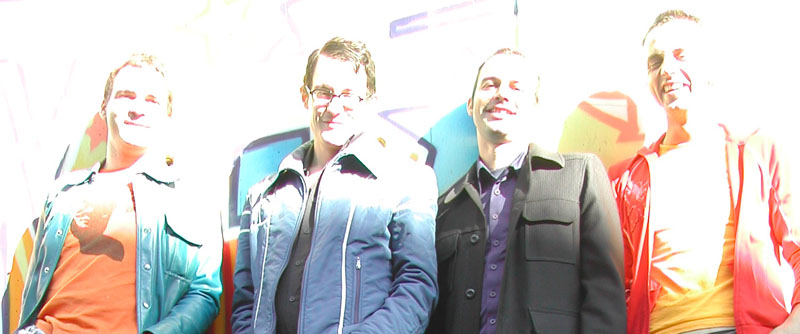
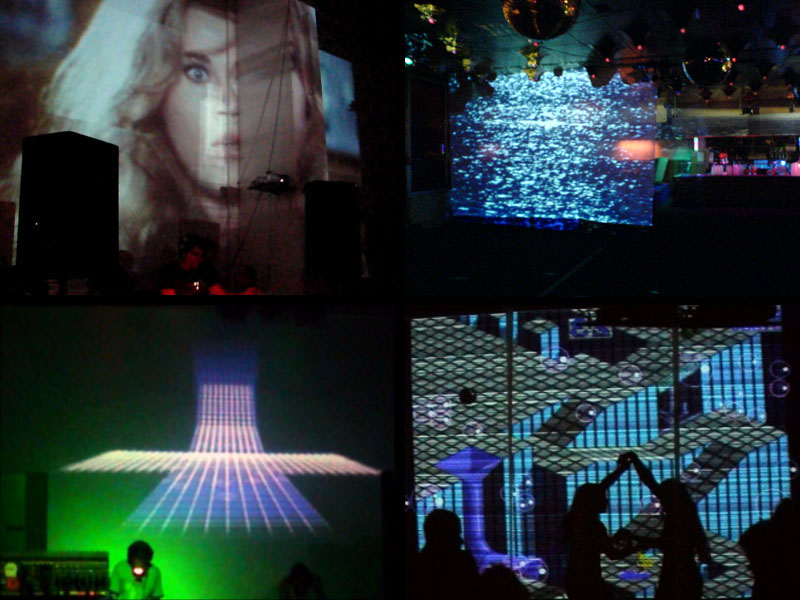
We regularly tour as the Scheinwerfer Live Visuals Collective, where we create the visual experience at various electronic music events since 2001. Our live-composited and sound-driven visuals are designed to emphasise the theme of the event as well as taking into account the architectural framework. Not coincidentally, we have been labelled as “Club Scientists”: As stated above, our performances are deeply influenced by the momentary state of the Soundium research software platform. At the same time research is typically induced by specfic artistic performance goals.
Scheinwerfer has performed at some of the coolest locations around the globe, supporting world-class DJs and musicians like Jeff Mills, Rush, Miss Kittin, Dave Clarke, Josh Wink, Mouse on Marks, Jimi Tenor and many more.
The Exploding, Plastic and Inevitable Redux
Stefan Arisona and Steve Gibson, since 2006
Introduction
EPI Redux is re-imagining of the psychedelic classic The Exploding Plastic Inevitable, created by Andy Warhol with the Velvet Underground in the late 1960s. Rather than literally interpreting the original Warhol event, EPI Redux seeks to update psychedelia for the new millennium. Using an excess of technology the project immerses viewers in an overload of the senses and in a Gesamtkunstwerk where sound, vision, space and time coincide.
The core concept behind EPI Redux resides in both its communal nature and in its long-form. The piece has been performed by as few as two performers and as many as eleven. As all the performers are expert in their mediums this reconfiguration allows for considerable amount of spontaneity, while at the same time calling on them to apply their analytical skills in real-time. The modularity of the piece similarly allows it to take several forms and keeps the content both loose and ever-evolving. In this way the Redux is similar to the Warhol original, even as it veers dramatically from the sound and visual world of the late 60s.

Synopsis of Work (by Luc Meier, Swissnex San Francisco)
Switzerland’s Stefan Arisona and Victoria, BC’s Steve Gibson are media artists who have established a strong footing in academia while keeping their fingers on the throbbing pulse of the club scene, DJ-ing and VJ-ing underground. Grounded in the history of audiovisual tinkering, they take creative hints from illustrious forebearers to push multimedia environments into the next realm.
Arisona and Gibson joined forces in 2006 to create a digital-age reenactment of The Exploding Plastic Inevitable, the boundary-breaking multimedia show conceived in the 1960’s by Andy Warhol with the complicity of Lou Reed and his cult rock act The Velvet Underground.
A full-blown sensorium featuring giant projections of Warhol’s films, The Velvet Underground at their most dazzlingly abrasive, and dancers let loose from Warhol’s New-Yorker Factory, the original Exploding Plastic Inevitable (1966-1967) was, while it lasted, the most unique and effective discotheque environment prior to the advent of venues such as the Fillmore in San Francisco. In many ways, it remains a benchmark for all subsequent immersive multimedia shows.
Originated under the auspices of ETH Zurich’s “Digital Art Weeks” and Victoria’s “Interactive Futures”, Arisona and Gibson’s take on Warhol’s circus makes full use of digital technology and the free-flowing, associative thinking of the techno age. Armed with multiple projectors, a barrage of laptop computers and additional data-churning devices, the pair have already performed in Zurich, Victoria, Chicago, Vancouver and Shanghai.
Using custom software, live vocals, keyboards and live video processing risona and Gibson create an immersive audio-visual experience which mimics the psychedelic atmosphere of the original EPI event, while at the same time updating the audio-visual language to the 21st Century.
Resources
Photos, videos and sounds at the Exploding, Plastic & Inevitable site: https://www.telebody.ws/Exploding/
Initiators and main artists: Stefan Arisona & Steve Gibson
Guest artists: Jackson 2bears, Randy Adams, Agitpop, babel, Dyz, I send data live, Tom Kuo, Love&Olson, Marcellus, Nuthre, Scheinwerfer, Sho-b, Adam Tindale
Event History
- Oct 20 2016 - Rolex Center, EPFL, Switzerland
- Mar 17 2012 - Velvet Underground, Zouk Club, Singapore
- Nov 12 2011 - NeOn Festival Closing Party, The Reading Rooms, Dundee, UK
- Sep 5-8 2010 - DRHA 2010, Brunel University, London, UK
- Jul 3, 2010 - Digital Art Weeks 2010, Xian, China
- Nov 17 and 19, 2009 - Phoenix Square Film & Digital Media Centre, Launch Events, Leicester, UK
- Oct 17 2009 - The Institute for Converging Arts and Sciences, Launch Event, Greenwich University, London, UK
- May 29 2009 - Computational Aesthetics at the Delta Ocean Pointe Hotel, Victoria, Canada
- May 12 2009 - Cantos Society, Calgary, Canada
- Sep 18 2008 - Santa Barbara Nights Closing Party, Santa Barbara Museum of Art, Santa Barbara, CA, USA
- Aug 21, 2008 - Transdisciplinary Digital Art Canadian Book Launch, Open Space, Victoria, Canada
- Aug 1, 2008 - Swissnex San Francisco, Swiss National Day Celebrations, San Francisco, CA, USA
- May 31 2008 - ELO Visionary Landscapes Conference, Northbank Artists Gallery, Vancouver, WA, USA
- May 22 2008 - Digital Art Weeks +, Shelter Club Shanghai, Shanghai, China
- Apr 24 2008 - Conaway Centre, Columbia College Chicago, Chicago, IL, USA
- Nov 17 2007 - Interactive Futures, Open Space, Victoria, Canada.
- Jul 14 2007 - Digital Art Weeks, Zurich, Switzerland
- Oct 21 2006 - Open Space, Victoria, Canada
Computer-assisted Media Authoring Techniques
Stefan Arisona, research fellowship at UCSB, 2007 - 2008
Project Summary
The volume of digital media content has enormously grown in the recent years: Emerging internet-based applications, such as YouTube or MySpace, are media-rich, emphasise on content sharing, and attract huge communities. As the volume of content further expands, we see an increasing need for not only being able to annotate and retrieve content, but also to produce and edit content in a computer-assisted manner and by employing (semi-) automated methods. However, existing work so far does not satisfy these needs – both in terms of usable software instruments as well the underlying theoretical frameworks. This viewpoint is also acknowledged by upcoming European Union IST projects: The Framework Programme 7 (FP7) calls for projects addressing Intelligent Content and Semantics and targets at advanced authoring environments for interactive and expressive content [ICT Programme Committee, 2007, Objective ICT-2007.4.2].
This project aims at a systematic classification and implementation of novel content authoring techniques. By “mixed-media content authoring” we understand the interactive editing, or the ‘‘composition’’, of content for multiple modalities (e.g., auditory and visual). The project emphasises on applying computational methods in order to enable a high degree of automatisation of the authoring process. It further aims at techniques that are concerned with expressive human-computer interaction and those that need to operate in real-time, where needed.
Central to the project is the hypothesis that existing traditional composition techniques from individual domains (e.g., music, graphics, video) can be identified, classified, and then be generalised in a foundational framework of interactive media composition techniques that is applicable to automated authoring tasks. We claim that the implementation of these techniques will lead to more effective methods for simultaneous mixed-media authoring. The project starts out by establishing a catalogue of media composition techniques. This includes collecting and classifying existing techniques from specific modalities, identifying common methodologies, and also filling gaps and building bridges with new techniques where needed. Before actually implementing the composition techniques, an appropriate real-time content rendering infrastructure is required. Here, the project benefits from preliminary work carried out at the former Multimedia Laboratory of the University of Zurich and at the Computer Systems Institute of ETH Zurich. As its central part, the project implements relevant composition techniques as part of an interactive media authoring instrument. Special thoughts are given to a human-centred approach in order to prevent results that are stigmatised by software, and in order to provide the highest possible degree of expressiveness to content authors. At its final stage, the project empirically verifies the results by means of concrete application scenarios from media art and entertainment.
The project brings together elements from many different fields, primarily from software engineering, human-computer interaction, and the foundations of multimedia, but also from music composition, film editing theory, and aesthetics. The intellectual merit of the project is to provide systematic foundational work on mixed-media composition techniques by exploiting computational methods and to validate the practicability of the theory in terms of usable software instruments. Besides of dissemination of scientific findings, the broader impacts of the project are expected to be very significant for a wide range of applications that depend on computer-assisted and automated content creation techniques: Among others, example beneficiaries are the entertainment industry or commercial content providers who can benefit from novel expressive authoring instruments, or emerging services beyond IPTV, where automated content composition tasks help supporting whole communities. Collectively, the project aims at advancing the state of the art of interactive media content authoring to a new level.

Project: Post-doctoral research fellowship, fully funded by the Swiss National Science Foundation (“Fellowship for Advanced Researchers”)
Location: Media Arts & Technology, University of California, Santa Barbara
Period: 2007 - 2008