
Tag: Visualization
17 posts tagged with "Visualization"
Visualizing Interchange Patterns in Massive Movement Data (EuroVis 2013)
Authors: Wei Zeng, Chi-Wing Fu, Stefan Arisona, Huamin Qu
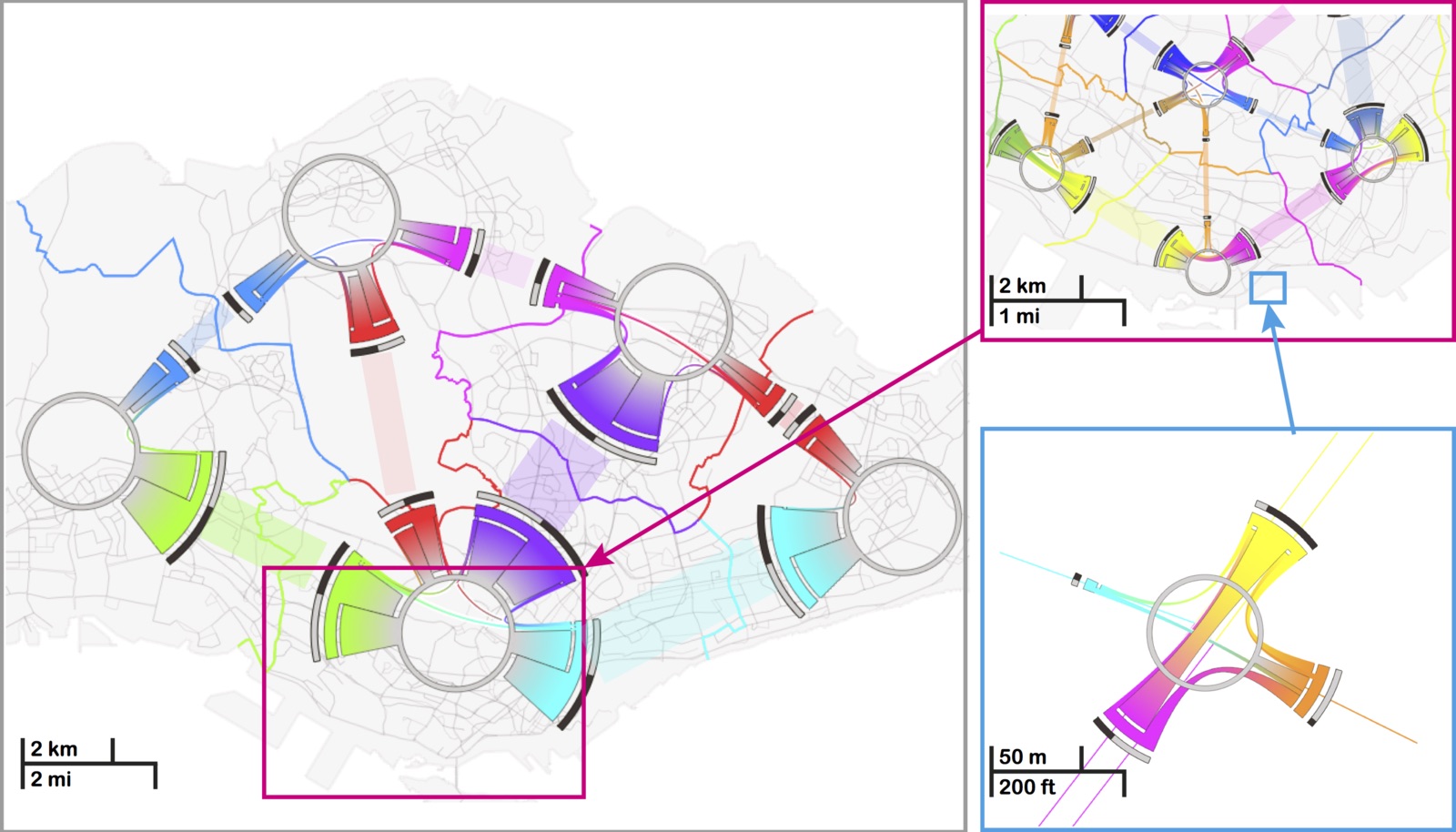
Abstract: Massive amount of movement data, such as daily trips made by millions of passengers in a city, are widely avail- able nowadays. They are a highly valuable means not only for unveiling human mobility patterns, but also for assisting transportation planning, in particular for metropolises around the world. In this paper, we focus on a novel aspect of visualizing and analyzing massive movement data, i.e., the interchange pattern, aiming at re- vealing passenger redistribution in a traffic network. We first formulate a new model of circos figure, namely the interchange circos diagram, to present interchange patterns at a junction node in a bundled fashion, and optimize the color assignments to respect the connections within and between junction nodes. Based on this, we develop a family of visual analysis techniques to help users interactively study interchange patterns in a spatiotemporal manner: 1) multi-spatial scales: from network junctions such as train stations to people flow across and between larger spatial areas; and 2) temporal changes of patterns from different times of the day. Our techniques have been applied to real movement data consisting of hundred thousands of trips, and we present also two case studies on how transportation experts worked with our interface.
https://www.youtube.com/watch?v=_QWnA1k2ZrU
Title: Visualizing Interchange Patterns in Massive Movement Data
Authors: Wei Zeng, Chi-Wing Fu, Stefan Arisona, Huamin Qu
Journal: Computer Graphics Forum
Publisher: Wiley
Year: 2013
Volume: 32(3)
Pages: 271-280
DOI: 10.1111/cgf.12114
Link: https://onlinelibrary.wiley.com/doi/10.1111/cgf.12114/abstract
Projections of Reality (smartgeometry'13)
Projections of Reality engages in augmenting design processes involving physical models with real time spatial analysis. The work was initiated at smartgeometry'13 at UCL London in April 2013 and is currently continued at ETH Zurich’s Value Lab Asia in Singapore.
The work explores techniques of real time spatial analysis of architectural and urban design models: how physical models can be augmented with real-time 3D capture and analysis, enabling the architect to interact with the physical model whilst obtaining feedback from a computational analysis. We investigate possible workflows that close the cycle of designing and model making, analysing the design and feeding results back into the design cycle by projecting them back onto the physical model.
On a technical level, we are addressing the challenge of dealing with complex, unstructured data from real time scanning, e.g. a point cloud, which needs processing before it can be used in urban analysis. We will investigate strategies to extract information of the urban form targeted for design processes, using real time scanning devices (Microsoft Kinect, hand held laser scanners, etc.), open source 3D reconstruction software (reconstructMeQT) and post-processing of the input through parametric modelling (e.g. Processing, Rhino scripting, Generative Components).
The goal of the workshop at smartgeometry'13 was to create a working prototype of a physical urban model that is augmented with real-time analysis. We worked with the cluster participants to formulate a design concept of the prototype and to break down the challenge into individual modules, e.g. analysing and cleaning the geometry, algorithms for real time analysis, projecting imagery onto the physical model.
Cluster Champions: Stefan Arisona, Eva Friedrich, Bruno Moser, Dominik Nüssen, Lukas Treyer
Cluster Participants: Piotr Baszynski, Moritz Cramer, Peter Ferguson, Rich Maddock, Teruyuki Nomura, Jessica In, Graham Shawcross, Reeti Sompura, Tsung-Hsien Wang
Year: 2013
smartgeometry/sg13: Constructing for Uncertainty
Good news to start the year with: Our cluster proposal “Projections of Reality” has been accepted for this year’s smartgeometry at The Bartlett of UCL from 15 - 20 April 2013 in London.
Cluster gurus: Stefan Arisona, Eva Friedrich, Bruno Moser, Dominik Nuessen, Lukas Treyer.
Projections of reality will engage in augmenting design processes involving physical models with real time spatial analysis.
The cluster will explore techniques of real time spatial analysis of architectural and urban design models: how physical models can be augmented with real-time 3D capture and analysis, enabling the architect to interact with the physical model whilst obtaining feedback from a computational analysis. We will investigate possible workflows that close the cycle of designing and model making, analysing the design and feeding results back into the design cycle by projecting them back onto the physical model.
On a technical level, we are addressing the challenge of dealing with complex, unstructured data from real time scanning, e.g. a point cloud, which needs processing before it can be used in urban analysis. We will investigate strategies to extract information of the urban form targeted for design processes, using real time scanning devices (Microsoft Kinect, hand held laser scanners, etc.), open source 3D reconstruction software (reconstructMeQT) and post-processing of the input through parametric modelling (e.g. Processing, Rhino scripting, Generative Components).
The goal of the workshop will be to create a working prototype of a physical urban model that is augmented with real- time analysis. We will work with the cluster participants to formulate a design concept of the prototype and to break down the challenge into individual modules, e.g. analysing and cleaning the geometry, algorithms for real time analysis, projecting imagery onto the physical model.
Workshop applications are now open - check out these links for further information:
smartgeometry @ web: https://smartgeometry.org smartgeometry @ facebook: https://www.facebook.com/Smartgeometry
Addis2050: Visualizing Future Energy Scenarios
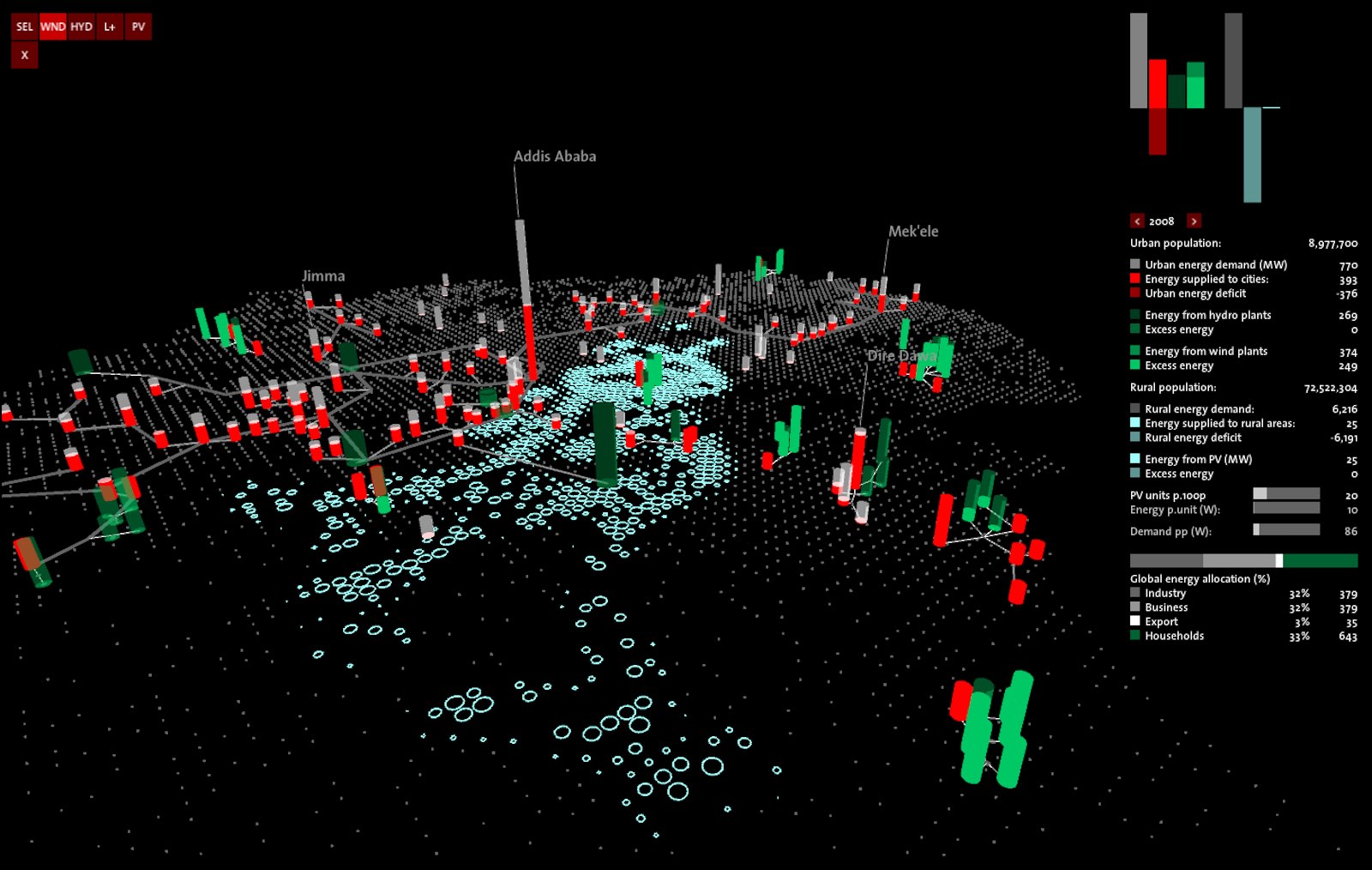
The energy scenario planning tool, developed by Eva Friedrich, has been presented at the ADDIS 2050 conference in Addis Ababa on October 9th and 10th 2012. The basic concept of the work is to create an intuitive and playful tool that allows for collaborative, interactive exploration of possible energy supply and consumption scenarios in Ethiopia. The users can move in time and compare different approaches to energy development in their effect: centralized hydro power, less-centralized wind power with local support, and completely decentralized solar power for rural, disconnected areas - thereby obtaining a better understanding of the effects of mid- to long-term energy planning.
The tool’s interface is built in a minimal style in order to keep the focus on the relevant points. It supports multi-touch surfaces, and borrows concepts from game engines, e.g. physics based animations for connecting networks.
https://www.youtube.com/watch?v=ymLicY8RHVY
The conference ADDIS 2050 – an alternative pathway into Ethiopia’s future – was held on October 9th and 10th 2012 at the campus of the Ethiopian Institute of Architecture, Building Construction and City Development EiABC in Addis Ababa. Addis Ababa belongs to the fastest growing urban centers in the world. Migration from the rural areas as well as massive redevelopment strategies of the City Government put the African capital under enormous pressure. Infrastructural deficiencies, water and energy shortages, environmental hazards and mobility challenges question the current modus operandi in place.
The Green Forum Ethiopia under the leadership of Heinrich Boell Foundation in Addis Ababa commissioned the Chair of Architecture and Construction Dirk E. Hebel at FCL Singapore in collaboration with the Ethiopian Institute of Architecture, Building Construction and City Development EiABC to invent an alternative “green” scenario for the city of Addis Ababa in the year 2050. The conference concentrated on the issues of Energy, Mobility, Cultural and Social Space, Housing and Information. The event was visited by more than 500 people and arose immense interest from the media as well as the City Administration. As guest of honor, the Swiss Ambassador H.E. Dominik Langenbacher attended the conference as well as delegates from several federal ministries and the UN-Habitat. In the meantime, the Department of Masterplanning and Vision of the City Adeministration invited the speakers to present the work in their offices.
Team FCL Singapore: Dirk Hebel, Felix Heisel, Marta Wisniewska, Alireza Javadian, Gerhard Schmitt, Stephen Cairns, Remo Burkhard, Eva-Maria Friedrich, Matthias Berger, Stefan Mueller Arisona, Ludger Hovestadt, Jorge Orozco, Alex Erath, Max Hirsh, Sonja Berthold, Ying Zhou, Edda Ostertag, Naomi Hanakata, Lindsey Ann Sawyer, Cheryl Song, Noor Faizah Binte Othman, Kevin Lim, Amanda Tan
Team EiABC: Joachim Dieter, Bisrat Kifle, Addis alem Fekele, Tewedaj Eshetu, Yosef Teferri, Eyob Wedesu
Team Green Forum/Heinrich Boell Foundation: Patrick Berg, Ayele Kebede, Jonas
Software Design and Development: Eva Friedrich
Energy Modelling: Matthias Berger
Principal Investigators: Gerhard Schmitt & Stefan Arisona
Institution: Future Cities Laboratory, ETH Zürich
Period: August / September 2012
Book: Digital Urban Modeling and Simulation
Edited by Stefan Arisona, Gideon Aschwanden, Jan Halatsch, and Peter Wonka, 2012
About this Book
This book is thematically positioned at the intersections of Urban Design, Architecture, Civil Engineering and Computer Science, and it has the goal to provide specialists coming from respective fields a multi-angle overview of state-of-the-art work currently being carried out. It addresses both newcomers who wish to obtain more knowledge about this growing area of interest, as well as established researchers and practitioners who want to keep up to date. In terms of organization, the volume starts out with chapters looking at the domain at a wide-angle and then moves focus towards technical viewpoints and approaches. (Excerpt from preface by Stefan Arisona).
Contents
Part I: Introduction
A Planning Environment for the Design of Future Cities - Gerhard Schmitt
Calculating Cities - Bharat Dave
The City as a Socio-technical System: A Spatial Reformulation in the Light of the Levels Problem and the Parallel Problem - Bill Hillier
Technology-Augmented Changes in the Design and Delivery of the Built Environment - Martin Riese
Part II: Parametric Models and Information Modeling
City Induction: A Model for Formulating, Generating, and Evaluating Urban Designs - José P. Duarte, José N. Beirão, Nuno Montenegro, and Jorge Gil
Sortal Grammars for Urban Design: A Sortal Approach to Urban Data Modeling and Generation - Rudi Stouffs, José N. Beirão, and José P. Duarte
Sort Machines - Thomas Grasl and Athanassios Economou
Modeling Water Use for Sustainable Urban Design - Ramesh Krishnamurti, Tajin Biswas, and Tsung-Hsien Wang
Part III: Behavior Modeling and Simulation
Simulation Heuristics for Urban Design - Christian Derix, Åsmund Gamlesæter, Pablo Miranda, Lucy Helme, and Karl Kropf
Running Urban Microsimulations Consistently with Real-World Data - Gunnar Flötteröod and Michel Bierlaire
Urban Energy Flow Modelling: A Data-Aware Approach - Diane Perez and Darren Robinson
Interactive Large-Scale Crowd Simulation - Dinesh Manocha and Ming C. Lin
An Information Theoretical Approach to Crowd Simulation - Cagatay Turkay, Emre Koc, and Selim Balcisoy
Integrating Urban Simulation and Visualization - Daniel G. Aliaga
Part IV: Visualization, Collaboration and Interaction
Visualization and Decision Support Tools in Urban Planning - Antje Kunze, Remo Burkhard, Serge Gebhardt, and Bige Tuncer
Spatiotemporal Visualisation: A Survey and Outlook - Chen Zhong, Tao Wang, Wei Zeng, and Stefan Arisona
Multi-touch Wall Displays for Informational and Interactive Collaborative Space - Ian Vince McLoughlin, Li Ming Ang, and Wooi Boon Goh
Testing Guide Signs’ Visibility for Pedestrians in Motion by an Immersive Visual Simulation System - Ryuzo Ohno and Yohei Wada
Publication Information
Publisher: Springer, Berlin Heidelberg
Series: Communications in Computer and Information Science, Vol. 242
Editors: Arisona, S.; Aschwanden, G.; Halatsch, J.; Wonka, P.
Year: 2012
ISBN: 978-3-642-29757-1
Link: https://www.springeronline.com/978-3-642-29757-1